
Scotland Branch Meeting Report 14/3/2026
In March we had a presentation by Branch member Jon Reglinski. Jons’ talk was entitled “Design for Accuracy: Scottish Domestic Regulator Movements”.
Jon is the owner of James Ritchie Clockmakers in Edinburgh. First established in 1809. Jon himself has been repairing clocks for over 25 years. As a result, he has seen and worked on thousands of Scottish clocks. Many of them regulators. But what exactly is a regulator? There is no one perfect design or description. However, a clock designed for the purpose of being as accurate as possible, rather than decorative appeal or convenience gets close.
A ‘pure’ regulator would be designed to have a minimum number of wheels. Built to a high standard and typically be better than a few seconds per month in rate. The simple mechanism reduces friction which is the enemy. These clocks do indeed exist. The simple mechanism often resulting in 3 separate dials for hours minutes and seconds. The motion work eliminated to reduce errors.
There is, however, another class of clock. These are ones containing many of the elements of regulator design but with added complications. Jon described these as ones made for the ‘customer from hell’. They wanted a clock with all the accuracy but wanted a single dial, chimes, fancy cases. Etc. Such commissions were undertaken by some of the greatest clockmakers. Jon showed us many fine examples of movements that he had worked on. He pointed out the design details that elevated these above the rest. Typical features included moving the wheel trains to a more central position between the plates. The fine details of the escape wheels. High numbers of leaves in the pinions. The thickness of the plates. The refinement of the smallest details.
Yet many of these movements were not signed. One theory put forward was that the maker was experimenting with design features. At the end of the development process these movements were sold off rather than scrapped. Thus, a clock with a less well-known makers name could have an above average movement. All the evidence points so far to Thomas Reid/Reid and Auld making these hybrid experimental escapements and then flogging them to other local makers.
Jon showed us examples from his past servicing of such movements. One was a double-sided clock from Register House. There was no maker on either dial, but the movement was way above the expected. Why make an exceptional clock but take no credit for it? One of the features Jon pointed out was a particular shape of back cock. It is so distinctive as to be not just a design chance. Readers are asked to look around and see if this design occurs in any English clocks.
My thanks to Jon for a detailed dive into our local horological past. There were many comments and questions afterwards. Pendulum design, Material choices, Just how accurate were they? Jon has several examples in his own collection. He has promised to measure their performances a give us an update on what he finds.
Richard Thomson, Secretary Scotland Branch.
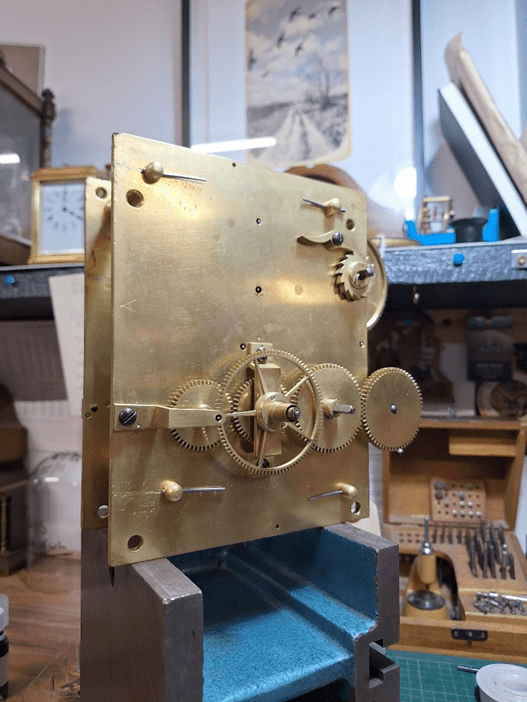
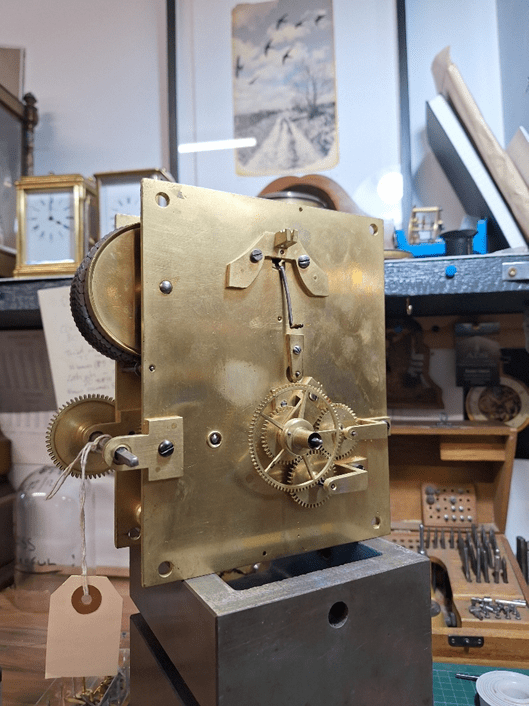
Double-sided movement with distinctive back cock.
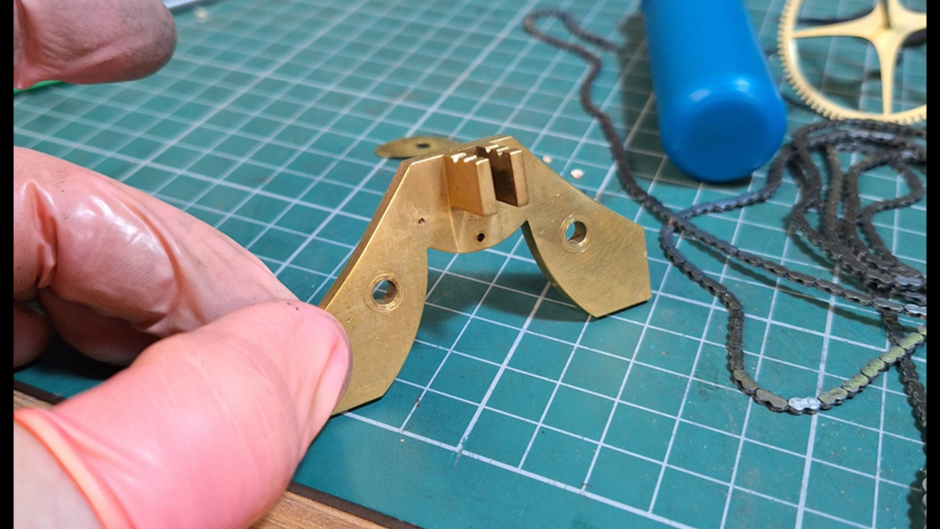
Closeup of back cock
Scotland Branch Meeting Report 14/2/2026
In February we had a presentation by Branch member Zen Chowaniec. Zens’ talk was entitled “How (Not) to Overhaul a 30 Hour Clock”.
Zen is well known to the branch for doing meticulous repairs to a wide range of clocks. It was a little surprising to find that this was his first 30 hour movement. Not that he was presented with much of a movement by his customer. A box of bits, perhaps not all from the original movement, was handed over. It seems that the customers father had embarked on a modification. The clock is signed W. Barnard of Newark, number 524. dated to later in the second quarter of the 18th century.
This 30 hour movement originally had one weight and an endless chain. (The Huygens endless loop system.) It is thought that it had been or was in the process of being converted to separate weights and chains for striking and going trains. There were two weights but still only the one click. It is unclear if it ever operated like this. It was decided to put the movement back to as near original as possible. Both chain sprockets would have to be replaced as they were different and could not use a common chain. A conversion kit was chosen as it allowed the original cheeks to be retained thus preserving the original look.
Zen took us through the process he followed to inspect, clean and repair all the parts. With some relief all the bits were there, if not in terribly good condition. Some rebushing and repivoting was required. The taper on one great wheel arbor and the barrel shape on the other great wheel arbor had been filed away. Minimum dressing was undertaken to at least return the arbors to a rounder form A new centre pipe for the strike train chain sprocket had to be made. Careful inspection showed that the pallet arbor was bent. This was a substantial diameter and would have been unlikely to have been accidental.
The clock only has the one hand. Thus there is no need for the escape wheel to rotate once per minute. A careful tooth count revealed that a beat rate of 3584bph rather than 3600 existed. Setting up to 3600 would give an error of 6.5 minutes per day.
Zen explained the teething troubles he had setting the rebuilt clock up. The pendulum amplitude was very low. The cause being excessive escape wheel tooth drops. Suddenly it became clear why someone in the past had used some effort to bend the pallet arbor. Needless to say Zen did a more professional adjustment to reduce the drops. Associated with the small amplitude there was a resonance in the pendulum rod, interacting with the crutch, causing bursts of rapid time gain. A stiffer rod was substituted to ensure that this did not recur. At the request of the customer a novel strike/silent feature was added to the clock.
My thanks to Zen for a highly enjoyable afternoon during which we all improved our knowledge. This was very much NOT a ‘how not to’ exercise. One of the many discussions afterwards was on clock cleaning chemicals and how to dispose of them properly. Local authorities generally are unwilling to help and commercial operations charge high fees. Answers anyone?
Richard Thomson, Secretary Scotland Branch.
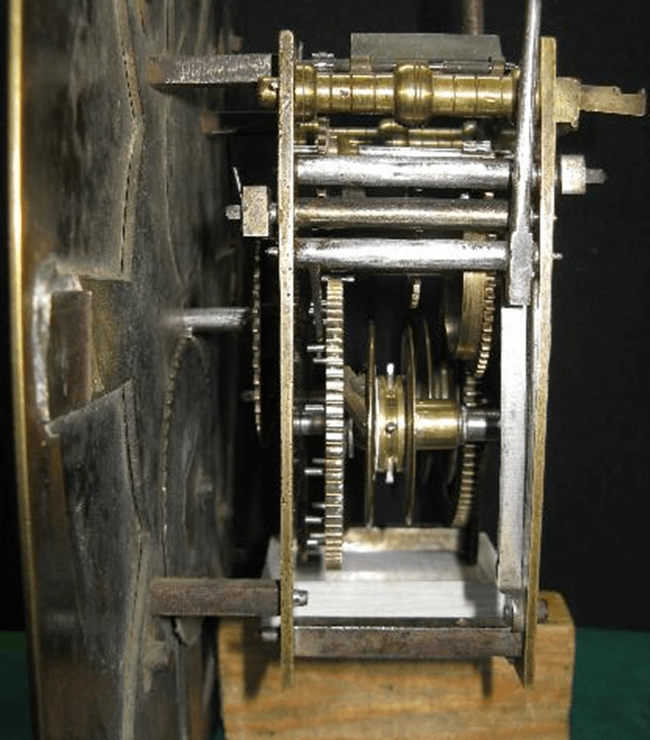
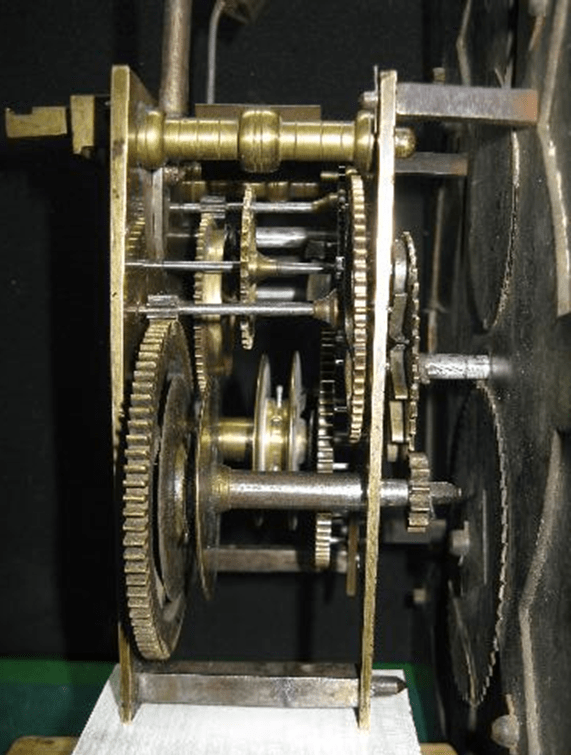
Side views of the rebuilt movement
Scottish Branch Meeting Report 8/11/2025
In November we had a presentation by Branch member Angus Brown. Angus’ talk was entitled “Surprises and Discoveries in British domestic 17th, 18th and early 19th Century Clocks”
Last month we were basking in the fanciful world of hypercars, this month Angus brought us right back to our home topic with an in depth look at longcase movements. Many of us who gathered to hear him have worked on, serviced or at least setup such a movement. Few of us will have delved into the detail of the parts in the way Angus has. Generally, we have accepted that the “Joe Bloggs” on the dial possibly did not make all or any of the parts inside. We probably did not consider just which parts were bought in, and which were made. Indeed, it is not even that simple. Wheels, for example, could be bought in as part of a movement, separate but fully formed or at any one of the intermediate stages of their fabrication.
Angus’ work has brought him into contact with more movements than most of us. As well as repairing them he has also studied the telltale marks that give us clues to the production processes involved. As an example, there are casting marks that can be found and used to identify the foundry. You can see that the pendulum back cock and the date ring were both made by the same foundry. It is possible to still detect after 250 years the faint scratches left by the maker as the depthing of bought-in parts was used to layout the plates. His experience lets him see the level of finish that the ‘maker’ has applied to items procured elsewhere.
This may seem largely academic, and it is, but when it comes to replacing missing parts such details can lead the way. A scratch here a curved line there will let you see how the original part was developed. As an example of this Angus showed us his methodology in remaking a missing wheel to drive a date ring. He can be fairly sure that his new part has all the same features and dimensions of the original.
There doesn’t seem to have been a time when a clockmaker did make everything themselves. There has always been a proportion of bought in components. Over 3 centuries the balance skewed to buying more finished parts in. However, there were exceptions at both ends of the period. It is fair to say that there was a ‘golden age’ where innovation dominated and new features were tried, and some regional styles were developed. Over time, centuries, what worked best began to dominate and innovation decreased. This would favour more centralised production even if parts were never interchangeable.
As a postscript to his talk Angus asked a question about cases. He had noticed that some have a baseboard. Others have nothing between a falling weight and the floor. Is there a pattern to this? I have started a survey in the Scottish branch. If any readers wish to add to it please let me know the following details of any cases that you can. Date, where made, and presence or absence of a baseboard. I will do my best to collate the results.
My thanks to Angus for making us think about the production process in depth. It will change how I look at movements in the future now that I know what to look for.
Richard Thomson, Secretary Scottish Branch.
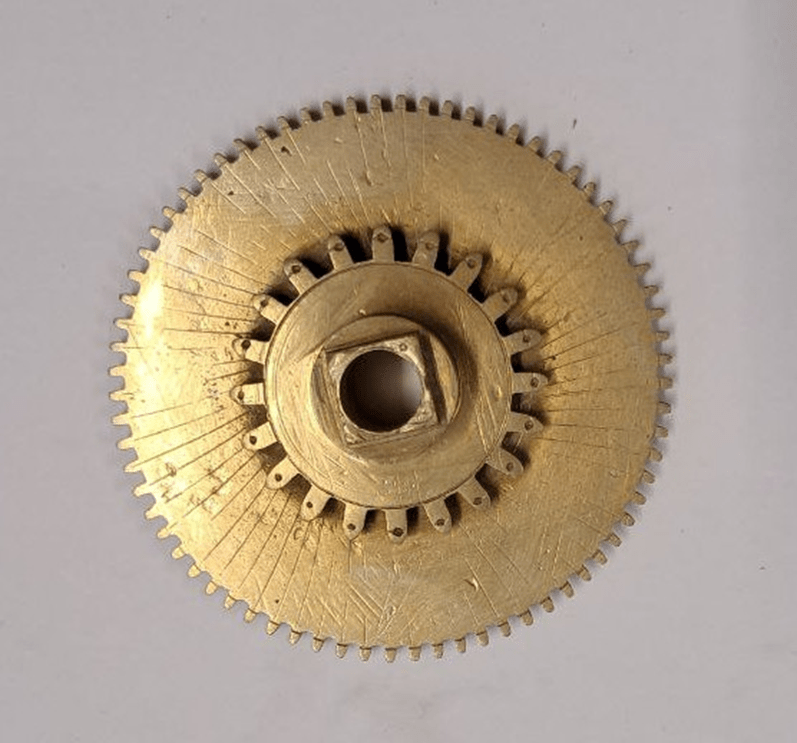
Hand Filed Wheel showing considerable evidence of how it was laid out prior to cutting.
Scottish Branch Meeting Report 11/10/2025
In October we had a presentation by Branch member Andrew Shedden. Andrew’s talk was entitled “From Formula 1 to Space, and Everything Mechanical in Between” with a promise to include some horology. Andrew is a director of AS Pro Engineering in Edinburgh. Their forte is weight reduction in Hypercars. A Hypercar is a sports car typically with a price tag of over a million pounds and over 1000 horsepower. One of the side effects of this post Covid period is there is a boom in such vehicles with corresponding budgets available for R&D.
More power and Less weight has long been the two sides of sports car design. Colin Chapman was the genius behind Lotus cars. His mantra was to design in lightness. He did this by intuition and, sadly, by getting it wrong. Things would break when too much weight was removed. However, for much of the time Jim Clark, Graham Hill and Lotus would win if they made it to the finish line.
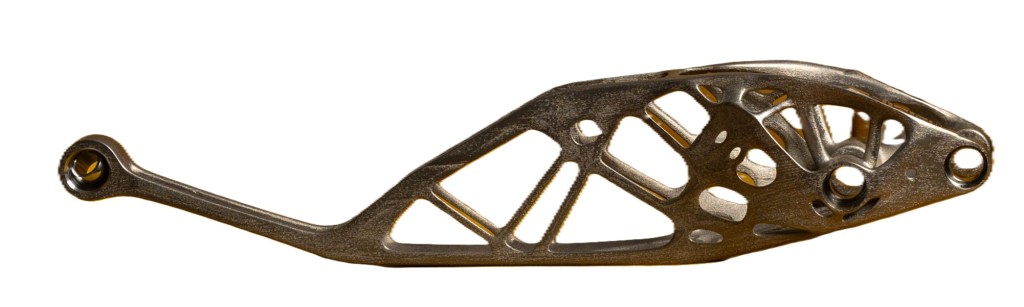
Nowadays, a computer revolution later, it is possible to design parts and simulate performance prior to any part being made. This goes in equal measure from suspension components to whole car bodies. Andrew used, as an example, a design study of a suspension lower control arm. Originally machined from a billet of steel. It could be made lighter using aluminium, lighter still with titanium. Each had different properties other than just weight. How much they bent under load and how much load to critical failure. These are obviously important for safety. However, the question remains of just how light can you go? i.e. just how little material and still have a useful and safe component. They solved this with a development program called ATOMS. Advanced Topology Optimised Metalic Structures. This exercise resulted in a structure with optimised weight for the expected loading. It looked nothing like the previous designs. It is much more something that you would expect nature to have developed over a few millennia of evolution. See Figure 1.
It is all well and good having a fancy shape, but it must be manufactured. Nowadays it is possible to 3D print, in metal, almost any shape by laser sintering of metallic powder. Presently parts take many hours to produce but the results are remarkable. The strength was above expectations and their 5 tonne test rig could not fracture it. Hypercars are niche but once developed this technology can be used much more widely. There are so many applications where low weight and high strength are desirable. Just think of prosthetics, spacecraft, crash helmets. The list is endless.
The organic nature of the resulting designs is, on its own, an interesting design language. Andrew is actively considering designs for wrist watches incorporating elements from the Hypercar world. With much of the evolved design hidden by bodywork some of it displayed on your wrist would be almost essential.
My thanks to Andrew for a fascinating glimpse of cutting-edge design technology.
Richard Thomson, Secretary Scottish Branch.
Scottish Branch Meeting Report 13/09/2025
In September we had our Annual General Meeting followed by a ‘Bring and Discuss’. Despite a number of apologies it was the best attended AGM since Covid19.
The AGM part of the meeting occurred without much ado. We have survived financially; and we had an excellent program of events last season. Sadly not all the events occurred as planned. Speaker illnesses required some last-minute program changes and two cancellations. Some caution is being used this season in not booking events so far ahead. The previous years AGM minutes were passed without modification and the current committee members were all reappointed. There was a request made for anyone who wanted to take a role in running any part of branch activities to step forward. No contribution too small.
The ‘Bring and Discuss’ had four presenters. Three of us chose to base our talks on items from Jon Reglinski’s recent clear-out. First up was Alastair Walker who had purchased a Keininger wall clock. It turned out to have one or two unusual features. Amongst them was a flywheel on the escape wheel arbor. This caused some speculation as to why. Keininger’s explanation was to smooth out the second hand and reduce the ticking sound!
Next up was myself who had bagged a non-working Kronowash automatic watch cleaner. Never one to pass up a challenge it is now operational. It is far from the latest model but it now passes through all the 5 stages of washing and drying. It was nice to work on something without a microchip in sight. All the operation is controlled by synchronous motors and cam timers. It could last for many more decades as a result. The faults were mostly sticky motors requiring lubrication. There was also some distortion of the main motor’s casting due to age cracking. This caused it to jam on its guide rails. This was easy enough to adjust out and it should be stable. As I have no need for a watch cleaner it is now looking for a good home.
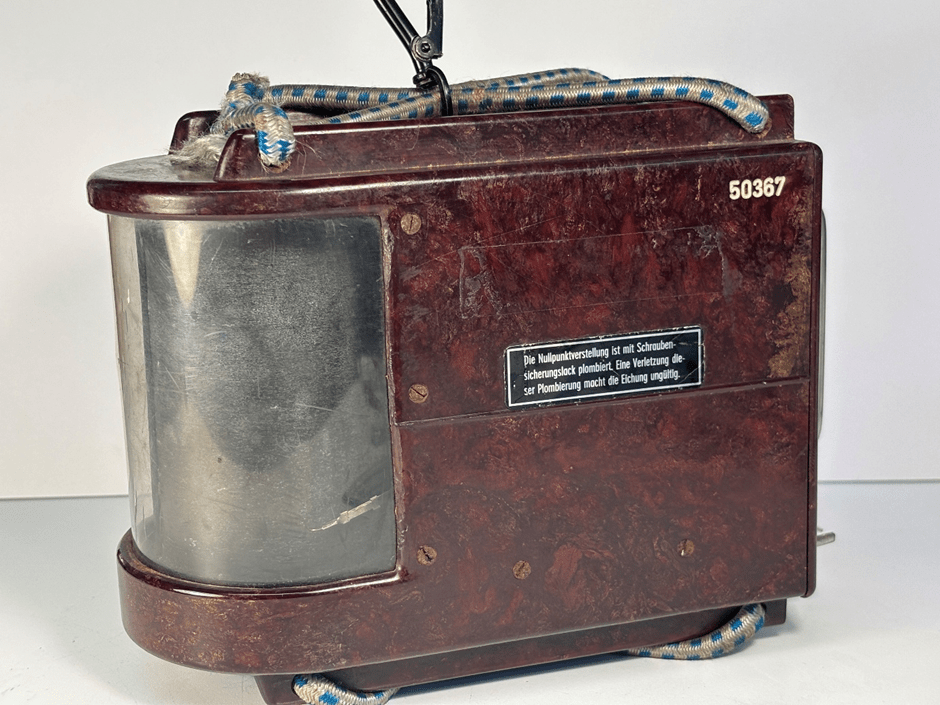
We then had a presentation by Mark Adams. He had brought along what looked like a barograph with a drum recorder. It was housed in a Bakelite case with bungee cords to mount it.
Translating the German label revealed it to be for recording the time and altitude of gliders, airships etc. Mark is a keen glider pilot and explained its purpose for recording flights to claim height awards. Of particular horological interest was that the mechanical drum recorder could be adjusted for 2, 4, or 10 hour duration. This is achieved by moving the escape wheel up and down to engage different numbers of teeth. This works very well but the tick can sound a little strange when first heard.
Our final speaker was Mark Baird who had acquired one of Jons longcase clocks. He has started with restoring the case. It was missing some moulding from the hood. To make a replacement he captured the profile in CAD and then used VCARVE to control a 3 axis mill to machine a new one from a piece of Oak. This was done in 2 passes. First, using a 6mm endmill and then a 3mm ball head mill. He admitted that to develop the process took a few days but it is a powerful technique to create any hard to replace profiles.
My thanks to all of the contributors who made it an interesting afternoon.
Richard Thomson, Secretary Scottish Branch.
Scotland Branch Meeting Report 12/04/2025
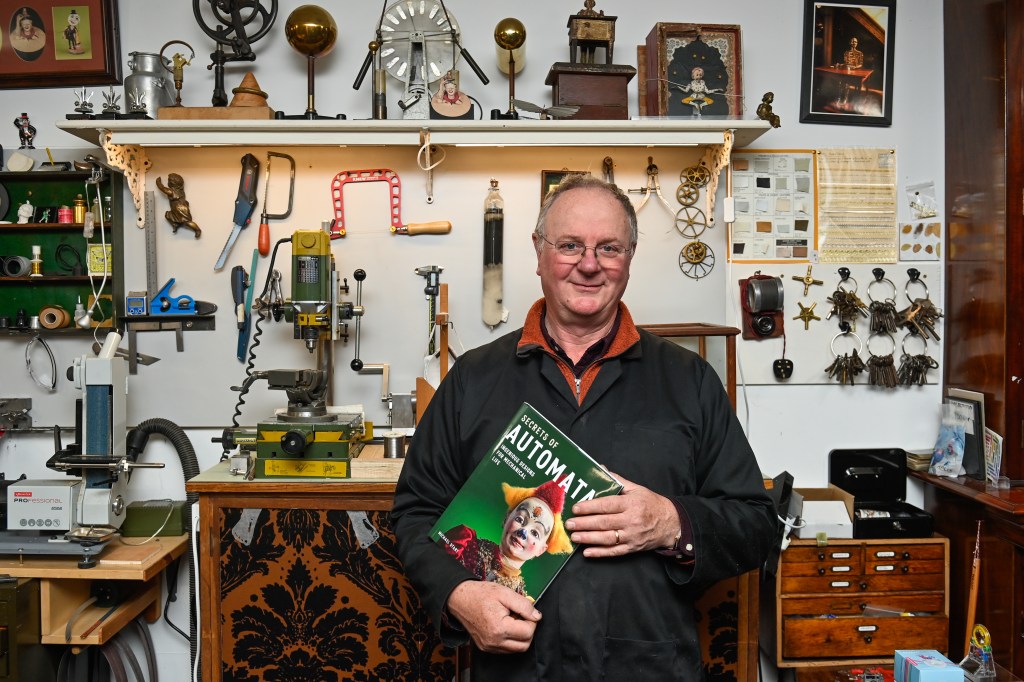
The April meeting was a talk by branch member and star of the small screen Michael Start. For those who do not watch “The Restorers” Michael and his wife Maria have appeared many times to work on Automata.
Michael outlined his journey from being a fireman in London to becoming a horologist to finally settling on the Automata that now consume his life. He was introduced to them by Jack Donovan who ran an Automata shop in London. They now run a museum “The House of Automata” in Forres. The museum combines the exhibition pieces, items for sale and the restoration business.
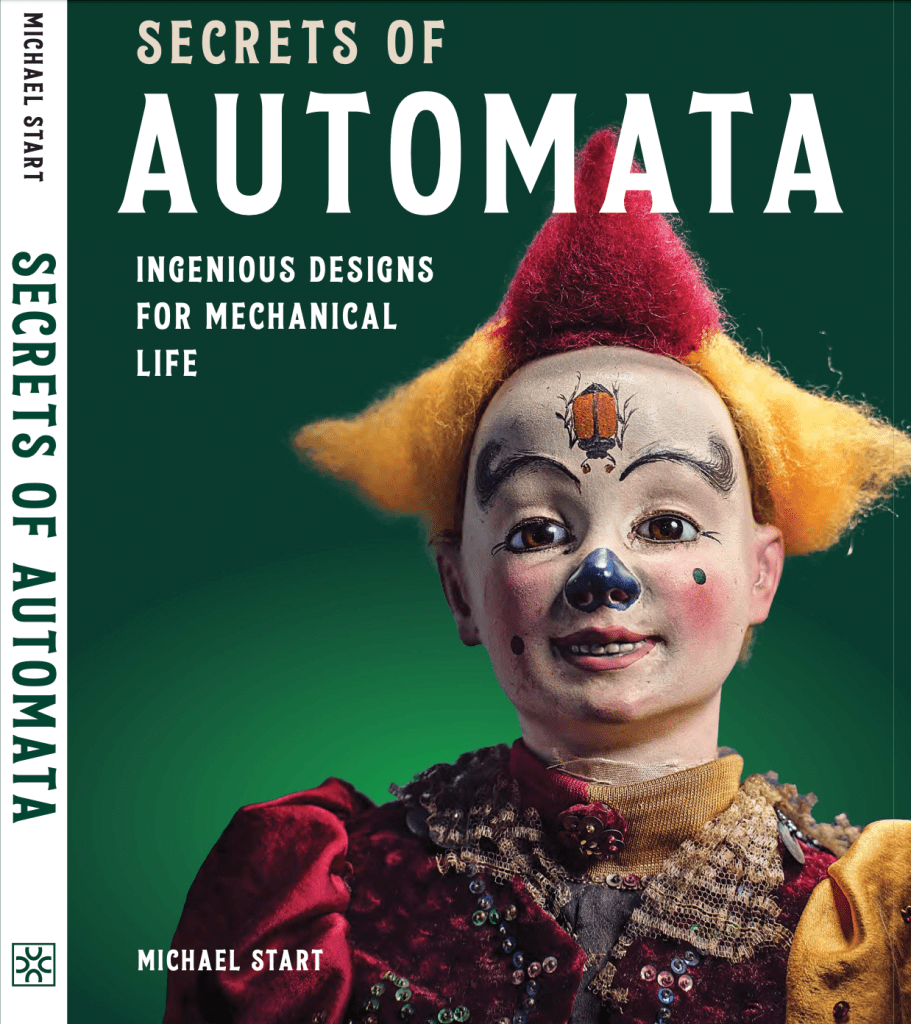
Most recently Michael wrote a book, if not ‘The’ book, on Automata. “Secrets of Automata – Ingenious Designs for Mechanical Life” One of the challenges was that there was no classification system for Automata. So, one had to be devised. i.e. Walking, Eating, Smoking, Birdsong and so on. In his talk he gave examples of each with pictures, videos, and technical drawings of the mechanisms to describe their operation.
Some were relatively simple mechanisms others could draw, paint & write. The most complex ones were even programmable. It is hard to imagine the wonder these must have created in their day. These days, when even doorbells have an App, we are used to it but back then it must have seemed like witchcraft.
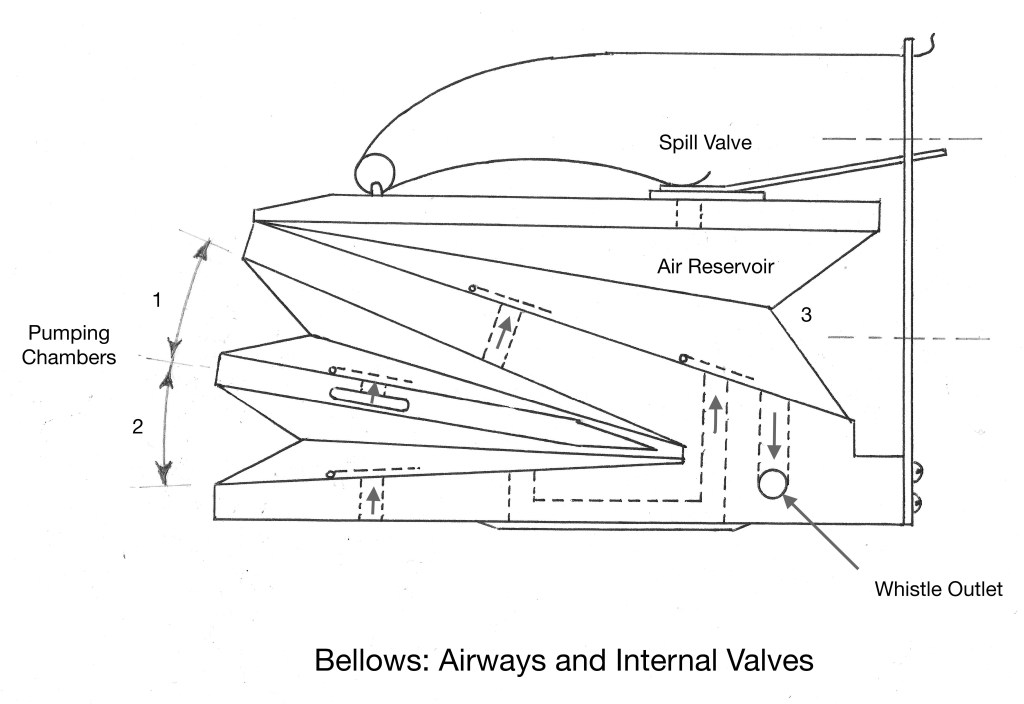
He also brought along some small examples so that we could hear the quality of the birdsong in person. He covered some tricky parts of the restoration process. How to remake bellows, seascapes, costumes, and more. It was a lot to fit into the time available and we all could have carried on into the evening.
Clearly, we need to buy the book, while it is still in print, and visit the museum. It would be a rewarding day out.
The branch extends its thanks to Michael for sharing his passion for his subject.
Richard Thomson
Branch Sec.
Scottish Branch Meeting Report 8/03/2025
The March meeting was a talk by local member and Horologist Lucas Marijnissen. “Heavy machining in a clockmaker’s workshop”. This turned out to be just a working title. “Heavy Machines in a Clockmakers Workshop” better describes the topic. Lucas moved to Edinburgh from his native Netherlands. Before he moved, he had built up a workshop at the back of his parent’s home. Like all of us machine tools are acquired as funds and opportunity arises. You get a chance to recover from the trauma of moving one before the next arrives. The downsides are masked by the excitement of a new tool. However as most of us find out moving home or workshop requires a special kind of fortitude. Lucas had to have this in spades as his move was across Europe.
The search for affordable premises, able to accommodate heavy machines, has since required subsequent moves around the Edinburgh area. So it is with some experience that he embarked upon his latest tool purchase. He had to leave his previous big lathe in the Netherlands and had since been on the lookout for another. Thus, when he saw a Schaublin 102VM for sale he did a deal. True it was near Liverpool, true it weighed 750 kgs, but it was a Schaublin. It was simply a matter of hiring a van, getting two mates to help and a long drive. As many of us have found an engine hoist also makes a good lathe hoist. Some metal roller-skates and a sling set completed the kit. Collection was achieved without much trouble until loading the van highlighted a snag. Whilst the van was high enough for the lathe it was not high enough for the lathe, sling and hoist arm. Somewhat like a Jaws “We need a bigger boat” moment. However, it fitted with a struggle. On unloading it was left in the yard behind the workshop as the next issue became clear.
Engine hoists are like Daleks, they do not do stairs, or narrow doors or slopes very well and he had all three to get past. He also thought it wise to get a structural survey of the workshop floor done. It could avoid a difficult conversation with the landlord. As the weeks turned to months, he had a few quotes for moving the remaining very short distance. These were from companies that specialised in moving heavy things like printing presses. Sadly, they were all more then the cost of the lathe. Finally, the stars at the Cumbria Clock Company, Father and Son Scobie-Young and Mark Crangle turned up with their engine hoist, skates, and bucket loads of enthusiasm to save the day.
Somewhat a cautionary tale but one that many in the audience could relate to. Used machine tools are at a considerable discount moving them is one reason why. The branch extends its thanks to Lucas for sharing his journey.
Richard Thomson
Branch Sec.
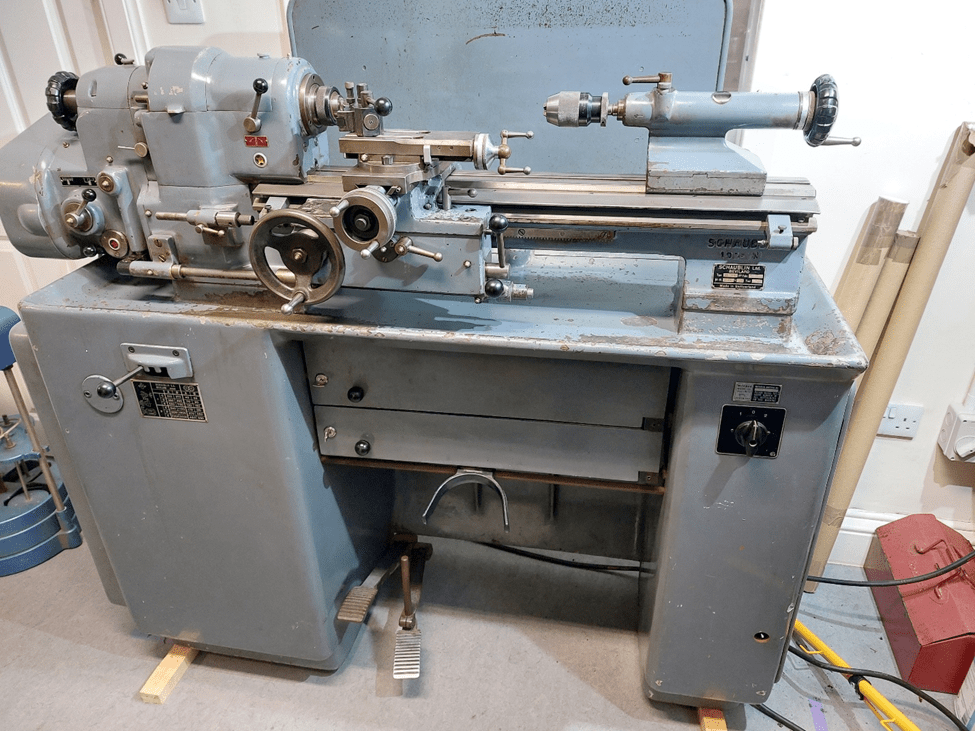
The Schaublin in its new home, finally.
Scottish Branch Meeting Report 8/02/2025
Many branch members will remember the Luxury of Time exhibition at the Museum of Scotland. Clocks from 1550-1750 which took place in 2019 when Covid was still in a laboratory. The exhibition exhibits were all from the personal collection of Dr John C Taylor OBE. Members of the branch had the luxury of a personal tour of the exhibition by John in late November 2019. Sometime later I heard that the collection was being reduced in size. A pity but I suppose inevitable as we are only the lucky custodians of such items for a brief period.
However, all was not lost. John had been diligently working over a period of 8 years making a digital record of many items. This provided the starter content for the Clocktime.co.uk virtual museum. So, we were delighted to welcome Dr Kristin Leith FSAScot and Dr Laura Young MBE to our February meeting. Kristin is the senior curator, and Laura is a director of the museum. We were also joined via zoom by John.
Laura started by giving us a little background to the collection and some of the highlights of Johns career and clock designs. The Chronophage clock series would be a whole talk on its own. Many of us have collections of clocks but I would bet that Neil Armstrong never made a visit to see them. However, to describe the collection as ordinary would be akin to calling the crown jewels a hat and a stick thing.
Kristin then gave us a tour of the website and a feel for the content therein. Alas this could not be live as the venues WiFi is too unreliable. If any reader has not yet visited the site, I implore you to do so. As you might expect there are super high-resolution images of the clocks with 360-degree tours. There are also the ‘Normal’ museum type of description labels. This is already great but there is so much more in this format. There are videos of presentations by John on each item. Describing its history and importance to the horological record. There are biographies of the horologists involved with hyperlinks to other artifacts, and associated history. Oh and the trick that makes me smile each time is that all the clocks show the correct time of day for the location that you log in from.
In the questions that followed it seems that less than 20% of the collection is online yet. Considering the work involved in production this is not surprising. Kristin showed us a current project. New research of Isack Pluvier Watch c1665 – an exhibit that will be unveiled later this year. So not only is it a brilliant resource now but it is being actively expanded.
The branch extends its greatest thanks to Kristen & Laura for this presentation and look forward to future visits.
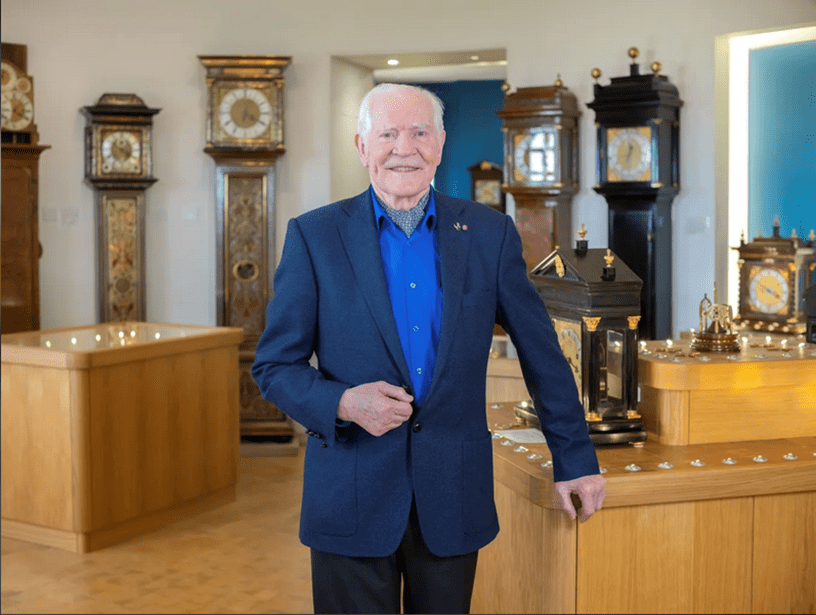
Dr John C Taylor OBE in his Collection Rooms
Scottish Branch Meeting Report 11/01/2025
In January our speaker was Ashley Strachan. Ashley, a past branch chairman, has always given good presentations and this one was no exception. “Replica Japanese Tsurigane – dokei” As we were to find out a Tsurigane dokei is a Temple Bell Clock. Ashley has given talks before on his passion for Japanese clocks, wadokei, of the Edo period (1603 – 1868) and his collection of examples. However it is near impossible to buy a Tsurigane dokei. He has only been able to find details of three past auctions. With a complete working one needing a second mortgage to secure a replica was the only path to adding to his collection.
The bell clock has the movement inside the bell. The dial is not easily visible and the indication of the passing of time is by striking of the bell. He started off with a French movement off eBay. The aim being to convert it to horizontal use inside the bell. There are a few complications. The pendulum is no longer going to function. It must be replaced by a balance wheel of some sort. The bell hammer no longer has gravity to assist it striking a gong. The clock uses temporal time not mean time. i.e. hour length varies day and night so that there are even numbers of day and night ‘hours’ throughout the year.
Last but by no means least wadokei Bell Strikes are counted down (not up) – Six divisions from 9 to 4. In some instances Mid-‘Hour’ Strikes; namely 1 strike after odd hours, and 2 strikes after even hours i.e. 9 – 1 – 8 – 2 – 7 – 1 – 6 – 2 – 5 – 1 – 4 – 2 . Good fortune came to the rescue here. If you ignore the 2 strike rule. You end up with the same number of strikes per 12 hours as a mean time clock with the usual 1, 2, 3, … sequence. By cutting a new strike wheel it was possible to get the correct sequence.
The aim was also to make the clock 24 hours per rotation of the hour hand and hence the clock has to operate at half normal rate. Refinement of the balance is ongoing but is currently good enough given the rather changeable duration of temporal hours.
Ashley described the solutions to the other complications and the fabrication of the new dial with adjustable period markers in the chapter ring. Please excuse the use of the word hour used above to mean temporal period. There are 12 such periods per 24 hour day. Rat, Ox, Tiger, Hare, Dragon, Snake, Horse, Goat, Monkey, Cock, Dog, and Boar. It can take quite a while to fully appreciate the complexity. In Mid-Summer central Japan the “Hour of the Horse” (mid-day hour of 6 hours from dawn to dusk) is 2hrs 35 min mean time, and in Mid-Winter it is 1hr 38 min mean time.
Lastly Ashley had to come up with a mount to display the clock and allow the bell to ring. This is done in the form of a Japanese Shrine Tori Gate. Constructed out of solid oak it is a befitting piece of craftmanship to represent what is hidden by the bell.
The branch extends its greatest thanks to Ashley for another absorbing and educational presentation.
Richard Thomson
Branch Sec.
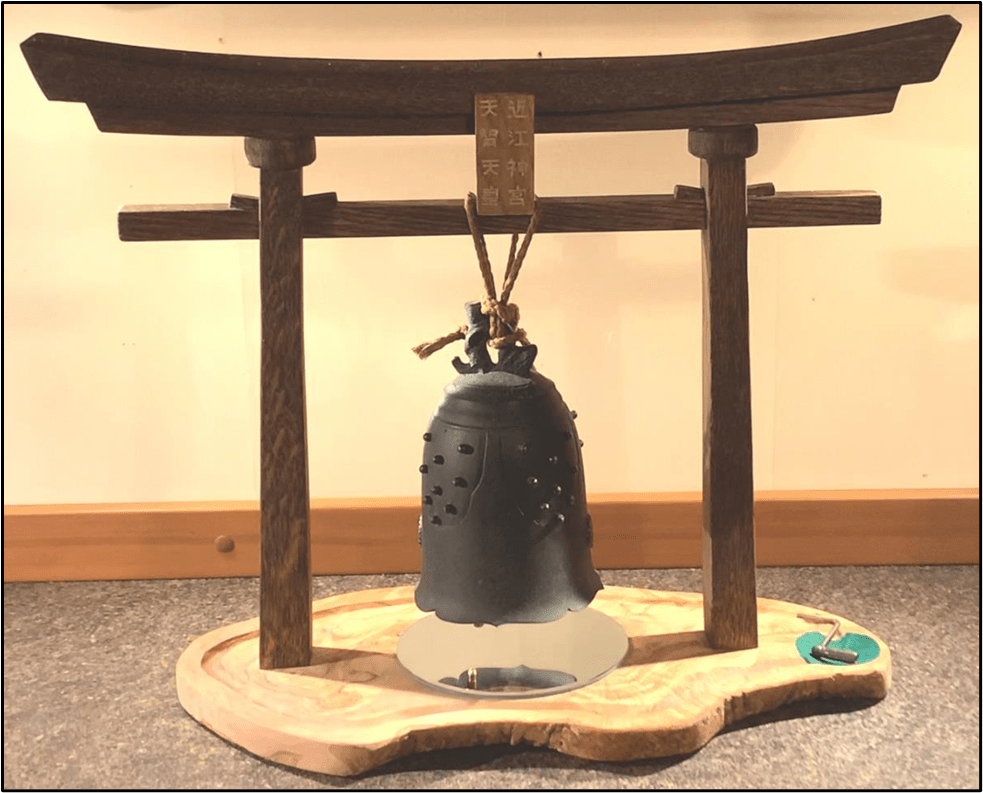
Completed clock. Mirror added to see the dial.
BHI Scotland Branch, 9th November 2024.
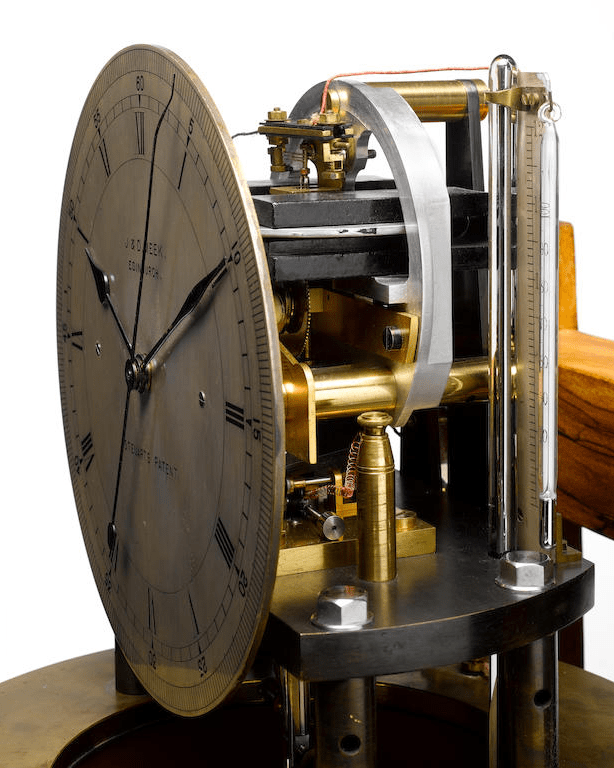
Our presentation was from our own Secretary, Richard Thomson. His subject was The Steuart Vacuum Regulator. Richard had heard about this Steuart Clock from the late Nick Sanders Hon. MBHI, who had studied this very clock.
A Steuart Clock has:
- Motion work continuously driven by a motor.
- A Pendulum used to correct the rate of the motor.
- As claimed in the patent: “The clock pendulum and movements are designed so they are never actually connected either mechanically, electrically or magnetically: the usual ‘escapement’ or any variations has been completely eliminated”.
In Steuart’s presentation to the Royal Society, Edinburgh, he claimed that his design was as accurate as a Graham escapement but cheaper to produce. His first clock was claimed to have an accuracy of “between one half and one second per month”, which he said, “was the limit of accuracy in air”.
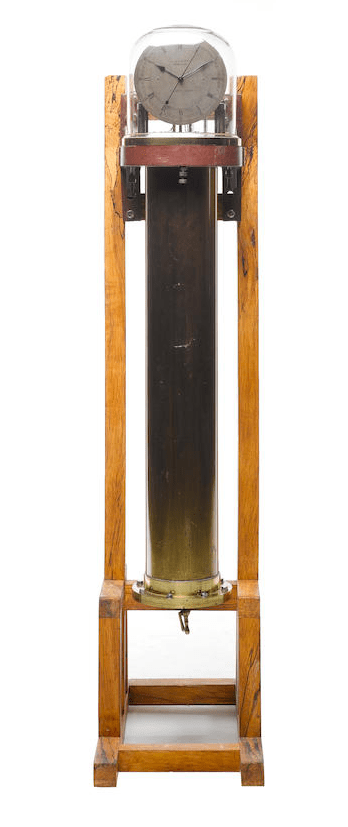
This clock was the only one ever made with a vacuum tank. It was manufactured by John Meek (1857-1934) of J & D Meek, The Mound, Edinburgh. It was displayed in his shop window for several decades. It was claimed to have an accuracy of better than a second per year. Steuart Clocks were also made by Ritchie’s of Edinburgh and Thomas Mercer’s of St Albans.
Richard was able to contact the current owner of the clock to find out more information about it. The owner was keen to have it working to its claimed accuracy and had it couriered up to Richard’s workshop. Richard had hoped that the clock just needed a minor adjustment or two. However, this turned out not to be the case.
There was significant change in the pendulum rate with 15 minute and 1 hour periods. In a conventional clock this would indicate an issue in the going train. However, this should not happen, in this clock, if the pendulum and motion work are truly detached.
Separating the motion work and turning it by hand exposed some binding. Further investigation exposed fragile design/manufacture in controlling the alignment of the plates and concentricity in one of the wheels. Not helped by the dials mass pulling on the front plate. The motion work was passed to another member, Zen Chowaniec, to resolve.
Meantime, Richard turned his attention to the pendulum. This is an Invar rod, with a very heavy bob with compensation tube, supported on knife edges. It would run badly for a few hours and then stop. Further investigation exposed a crack in one of the knife edges. Reassuringly, that crack was visible in Nick’s photos from 2012.
He consulted Jim Arnfield about knife edges. Jim’s advice was, the edges wear rapidly when using a heavy bob and the power required to drive them increases, don’t use them. These had been used initially on the “Project 150 clock” before being replaced by conventional spring suspensions.
Richard had no choice but to retain them, so a repair and re-hone was required. The clock now ran for 4 or 5 days without the knife edges drifting across the agate faces. The rate was not constant.
Further investigation unearthed the information that the Museum of Scotland had three others.
- Steuart’s own clock, also made by Meek.
- One made by Ritchies, gifted by Heriot Watt University.
- One made by Mercers, donated by John Romanes family.
A visit was arranged to the clock store to see them. They all differed in detail such as the design of the motion work and overall gearing. However, all used the same concept, motor and steel suspension springs. Alas none could be run and analyzed. The museum also had a wealth of background on this clock and the Steuart patent. One of the takeaways was that the topology of the circuit used to control the motor rate was different. This was tried on this clock and timekeeping improved noticeably.
The dial is effectively phase locked to the pendulum. Changes in the rate of the dial are corrected by the pendulum. However, a secondary effect of this is to change the timing of the gravity arm used to maintain the pendulum. Both the energy supplied and the time of it being applied change. This changes the amplitude of the swing and generates circular error. This was why binding in the motion work had such an effect on the rate.
In use there are many parameters that will change the phasing in this way. Supply voltage, knife edge wear, motor wear and drag in the motion work, changes in air pressure and moon induced changes to local gravity. Most of the initial claims, as judged by this clock, are flawed.
There are other Steuart Clocks out there. Richard Thomson would really like to test one of them.
Frank DiCarlo Treasurer, BHI Scotland Branch
Scottish Branch Meeting Report 14/09/2024
In September we had our Annual General Meeting followed by a ‘Bring and Discuss’. Sadly the list of members who had to send apologies was longer than usual. This coupled with my inability to login to the Canons Gait WiFi meant that it was attended only by those able to travel to Edinburgh. On the bright side the online members made do and had their own meeting. It will also mean that some BnD items will get a second airing.
The AGM part of the meeting occurred without much ado. We have survived financially; we had an excellent program of events last season and full program this season. The previous years AGM minutes were passed without modification and the current committee members were all reappointed. There was a request made for anyone who wanted to take a role in running any part of branch activities to step forward. No contribution too small.
The BnD had two presenters. First up was Alastair Walker who had made a grasshopper escapement during the summer. He showed pictures of Harrison’s first known wooden clock with a grasshopper escapement. You could see the origins of it being an anchor escapement clock that had been modified. It brought home the great intellectual leap to the grasshopper arrangement. It is not a trivial jump nor one that could be easily evolved from the anchor. It would be my first, ok second, use of a time machine to see how this came about and how many prototypes were rejected along the way. However without a time machine Alastair had made a functioning escapement of his own along with a video of it in operation. Considering how many variables there are it is a notable achievement that it ran as well as it did. I wonder if it will now be turned into a full movement.
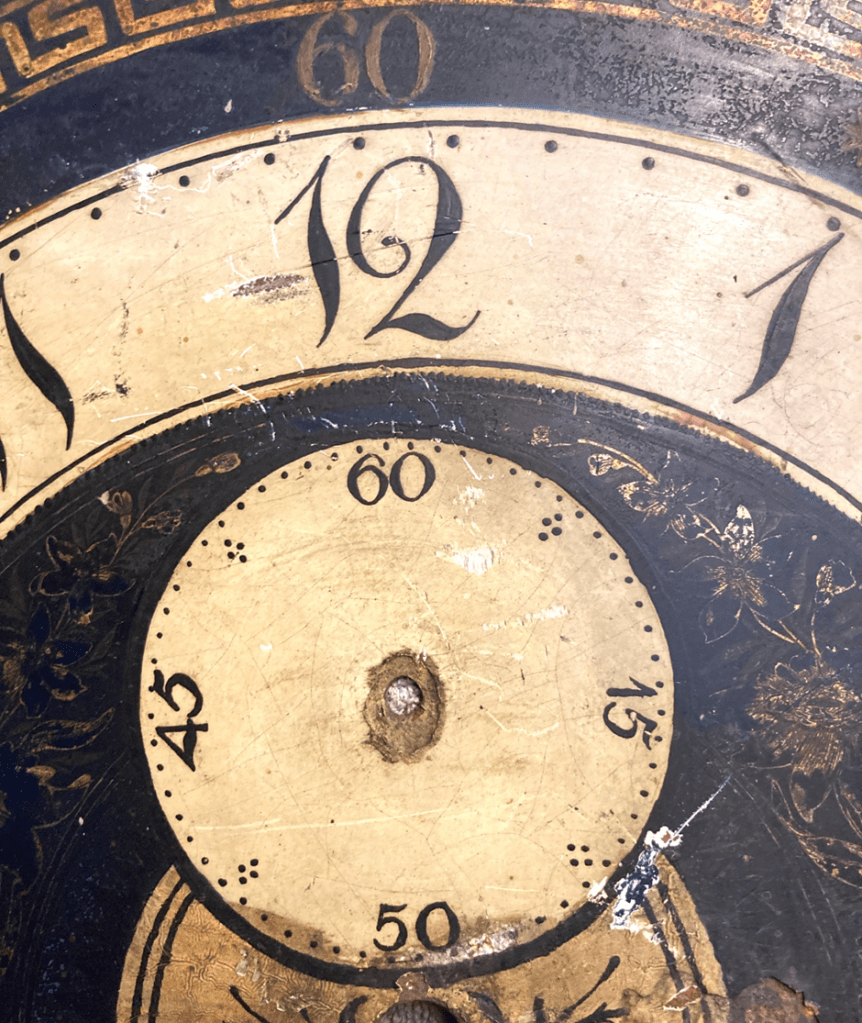
Next up was Angus Bell who has been restoring an 8 hour clock with an interesting dial. Circa 1820 accredited to Robertson Of Perth the dial is interesting more for its faults than its quality. After describing the movement and dial with photographs we discussed just how common such details could be. Two issues in particular caught our attention. The first was the use of a dummy winding arbour to get a symmetrical pair of winding holes. This is fairly understandable in terms of the desire for symmetry. The second is less understandable. The seconds dial was numbered 60, 15, 50, 45. Once seen the 50 at the 30 position stands out. Could it really never have been noticed? Again a time machine needed for a definitive answer but a talking piece for now.
The next two presentations were going to be from members online. Alas this was impossible so we closed the meeting on time for a change. My greatest thanks to all who attended and took part.
Richard Thomson, Secretary Scottish Branch.
Robertson of Perth Dial circa 1820
11 May 2024 – Cumbria Clock Company Factory Tour
BHI Scotland Branch Meeting Report 11th May 2024
The May meeting was a departure from the norm. In February 2022 we had an excellent talk by Mark Crangle on the Binns clock. An Edinburgh landmark that had just been restored by the Cumbria Clock Company. Last year I attended an AHS meeting and heard a talk by Keith Scobie-Youngs on an even more famous clock that they had just restored down in Westminster. In the post event small talk the offer was made to tour their factory sometime. I had no idea if any members would be prepared to travel to Dacre in Cumbria for the day. However I wanted to go and thought that I could perhaps fill the seats in my car with others. It turned out to be the best attended meeting this year possibly Century. Several even travelled down the day before.
We were hosted by Mark Crangle and William Scobie-Youngs. Will is the 3rd generation of the Scobie-Youngs involved with clock restoration. It was an access all areas, see everything, and ask any daft questions we could think of tour of their current premises. They will shortly be moving to a new location in Cumbria so this was possibly the last chance to see the old works.
There were many fine examples of tower clocks. We were able to see some in a completed state, some in pieces being restored and several undergoing test in the test area. I never knew Thomas Tompion made a tower clock but there one was. We moved onto the next workshop where they made auto winders. They explained their use of 3D printing to quickly make prototype replacement parts before committing the item to expensive metal manufacture. We saw examples of the gilding of hands and dials and the techniques and materials used were explained. We moved onto the machine shop, the domestic clock shop, the test facility. A complete nerd overdose from start to end.
One final item, that we were able to see, was the Edinburgh Time Ball. It has just been taken down for a much needed rebuild. The ball is much bigger and heavier that you could believe. It requires a piston damper to control the rate of descent. The ball itself is a wooden frame covered in zinc sheet. Our fair Scottish weather has not been kind to the wooden parts of the mechanism.
In common with other clock workshops that I have seen there were labels tied to movements and parts to identify them. However theirs commonly had the words ‘Palace’ or ‘Cathedral’ or ‘Castle’ as part of the name.
We were treated to a very fine buffet for lunch, endless tea and coffee plus one on one discussions with Mark and Will about what we had seen. Thank you Cumbria Clock Company for an excellent visit and especially Mark and Will for being so generous with their time. It was clear that they have a passion for what they do. Alas I am too old to send them a CV !
Richard Thomson
Branch Sec.
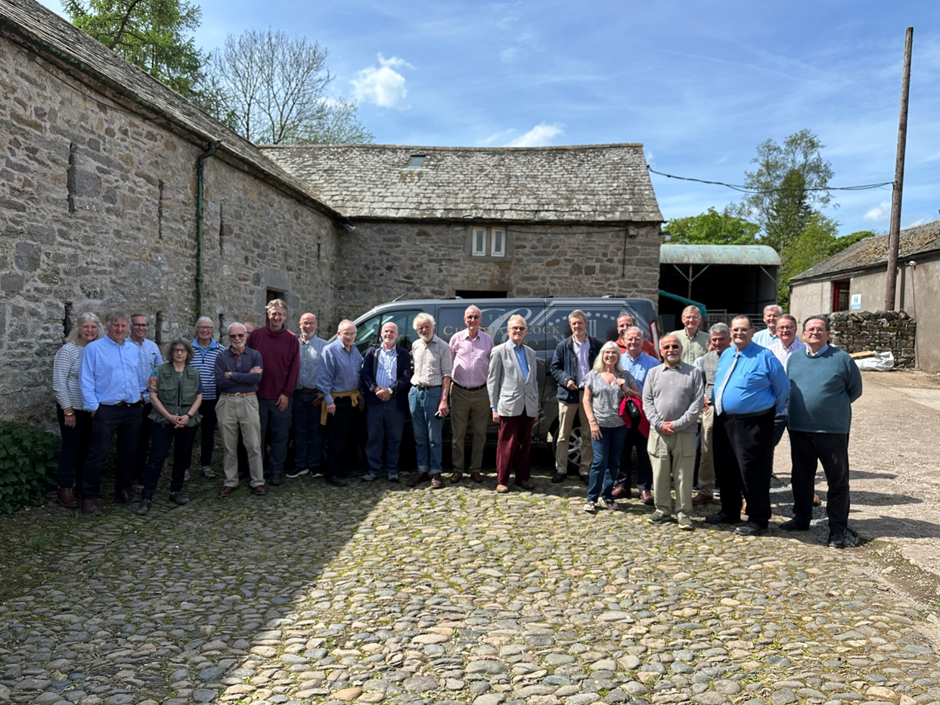
Some of the attending Scotland Branch Members rarely seen in the sunshine.
14 April 2024 – Antiquarian Horology by Dr James Nye
The April meeting was a talk by guest speaker James Nye. James is, of course, the chairman of the Antiquarian Horological Society. When I asked James if he would be willing to talk he kindly said yes and sent me a list of 4 titles to choose from! Thus his talk was entitled: ‘Edmund Howard (1710–98): The trials and tribulations of a Quaker clockmaker’ He correctly described it as “quite theatrical, with a lot of original material and first-hand account stuff”
James was exceptional in being able to paint a picture in our minds of London around the mid 1700s and Edmunds life in particular. His angle into this clockmaker was the bombing of Chelsea in the Blitz. So heavy and destructive was the raid of the night of the 16th/17th April 1941 that it became known to Londoners as ‘The Wednesday’. Whilst most parts of London were affected by this raid, on this occasion it was the western side of the capital that suffered most and large swathes of Chelsea. One part being Chelsea Old Church. Aside from the tragic loss of Yvonne Green and four other firewatchers in the church the destruction marked the end of the tower clock made by Edmund Howard. Although the movement survived largely intact it was not reused when the church was rebuilt. It was possibly last seen in the workshops of E. J. Dent & Co.
I won’t recount more detail of James’ talk to avoid ‘Spoiler Alert’ warnings but the story of how Howard became a clock maker, made a living, just, difficulty in finding good staff, sourced materials, and finally paid off his debts was a compelling yarn. I would also not be able to do credit to James’ research and his powerful delivery.
Our great thanks go to James for his presentation and glimpse into what it was like to be a Chelsea clock maker in the 1700s.
Richard Thomson
Branch Sec.
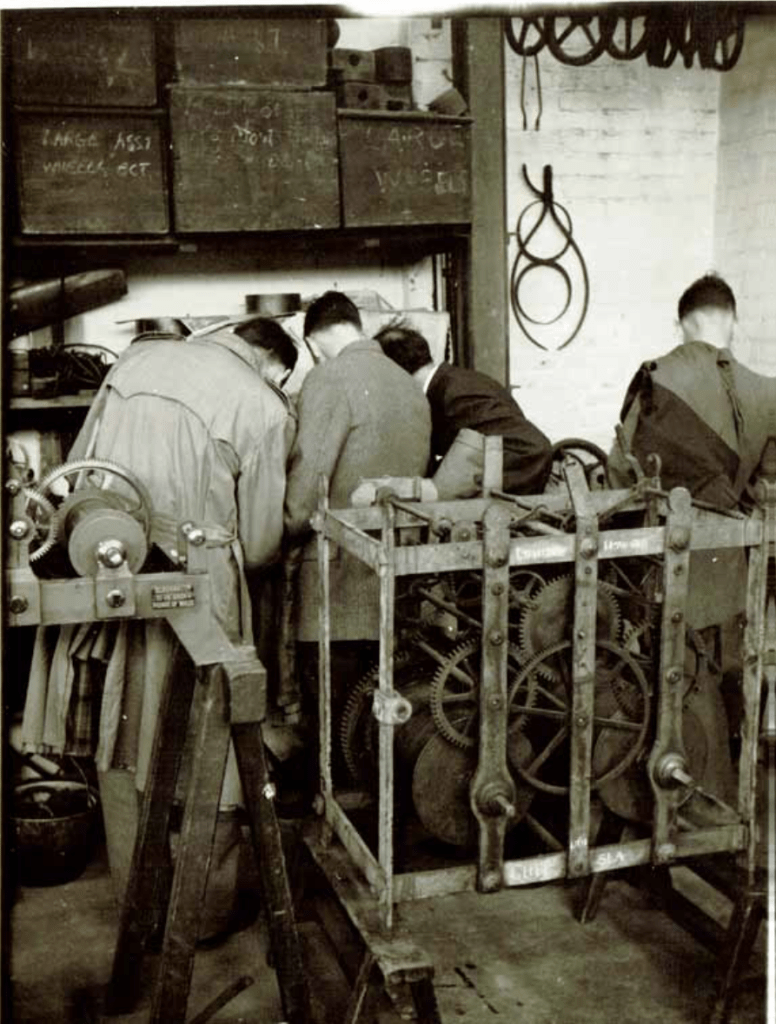
Dent’s works, AHS visit, Sept. 1957. Howard clock to the fore. Photo R. H. Miles
BHI Scotland Branch Meeting Report 9th March 2024
The March meeting was a Bring & Discuss event. We started off a little later than normal as our venue had been doubled booked. However no one complained about having to wait in the bar for a little extra time.
I had talked a little in January about my attempts at wheel cutting and I started off the meeting with a follow-up on Pinions. I have semi automated my mill and I can now rotate the stock and move the cutter in +-X under PC control. This has enabled me to cut some pinions that are useable. The EN8 steel stock required a cutting oil jet and some precise setting up. The total machine running time was about 6 hours to produce 2 inches of 12 leave pinion stock. I doubt that I would be able to do this fully manually without error.
Next up was Alastair Walker who had been tasked with finding a longcase clock for an acquaintance. The specification was reasonably clear in terms of physical attributes if not horological. He was able to find a match at auction and described it to the meeting. It was by William Anderson of St Andrews. Early 19th C. Interestingly it had a pendulum with a compensation tube. This I have only seen on precision regulators before.
He also has a longcase movement by D White of Culross for repair. It has a painted dial and rocking sailing ship in the arch. However all attempts of finding out about D White have so far drawn a blank.
Last, but by no means least, Angus Bell gave a talk on the Benjamin Franklin clock that he had made at Upton Hall during a 5 day course in 2008. Sadly, as far as I can see, this course is no longer available. The Franklin clock is interesting in that is made with only 3 wheels including the escape wheel. A result of this design is that the hour hand goes around once every 4 hours. The simplicity of the mechanism is traded off against the potential difficulty in reading the time. Angus took us through various options that constructors have used in the past to accommodate the fact that the hour hand pointing at the “3 O’clock” position could be indicating one, five or 9 O’clock.
Angus has devised a solution of his own whereby the hour numbers are on rotating disks with an aperture in the dial to allow the correct hour digit to be shown. Similar in operation to the date display in some other clocks. Four such disks are needed with a mechanism to advance them as required. I look forward to Angus being able to demonstrate a working solution along these lines.
Our thanks as always to all those who took part, asked questions, past comments and joined online from Europe and California for an enjoyable meeting.
Richard Thomson
Branch Sec.
10 February 2024 – Virtual: Making 248 – the Struthers’ first in-house movement by Dr Rebecca Struthers FBHI DGA MA FRSA PhD AFHEA
BHI Scotland Branch Meeting Report 13th January 2024
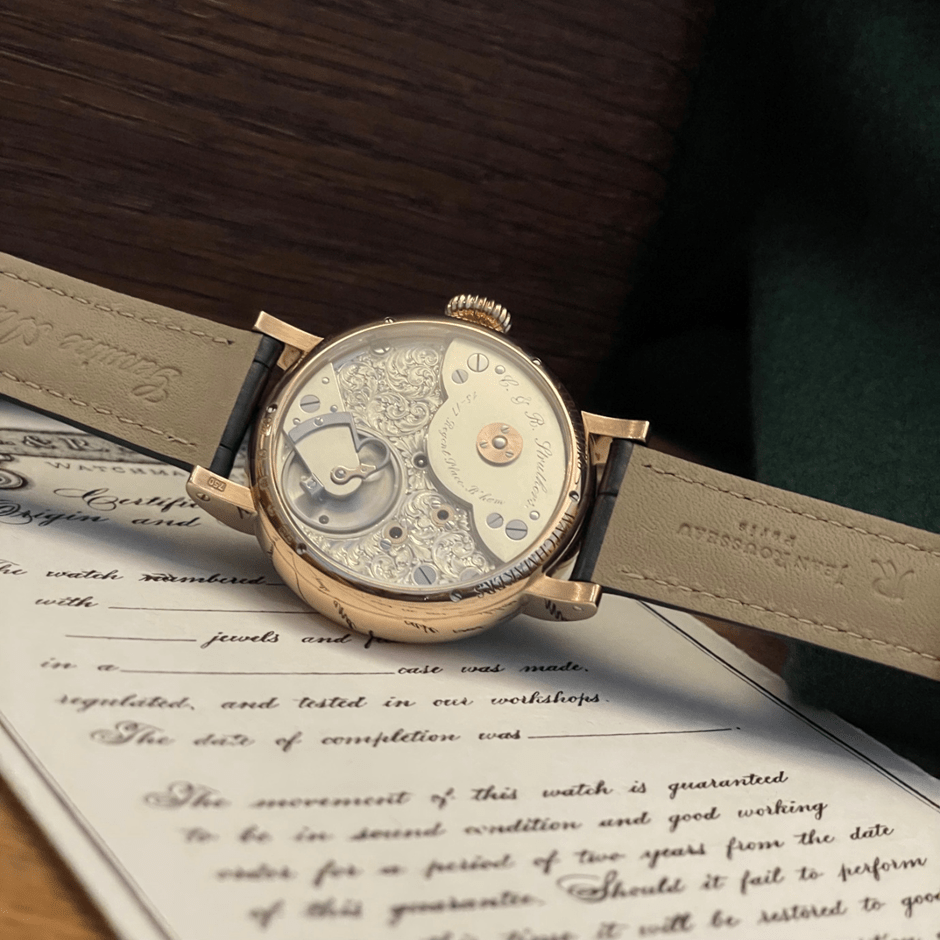
This month we were online to avoid the weather and the rugby crowds. More importantly we were joined by Rebecca Struthers PhD FBHI from her own workshop. She had offered to talk about her book or the Struthers 248. The 248 is her and her partners, Craigs, first complete movement. The name derives from there being 2 of them with 4 hands and an 8mm lathe.
She talked about her background and training from attending Birmingham City University, to meeting her partner, to getting into watch restoration. She had started off doing jewellery design and later transferred to horology. Sadly this path into horology is no longer available as the course has ceased to exist.
After a period establishing themselves as restorers the design bug was still there. This led to a chance Design Innovation Award competition entry, and subsequent win. It however launched them into a creative frenzy to make the ten week deadline to produce a complete, highly jewelled watch in platinum ruthenium. It was called Stella. One of their charming traits is to name everything including their machine tools. Most of the workshop tools were restoration projects in their own right. They have eschewed CAD/CAM design tools and CNC machines. Instead they prefer classic horological tools collected over time.
They had built a network of artisans in the jewellery quarter of Birmingham but ten weeks is no time at all. When the dust settled they were drawn to doing more than restorations and bespoke cases for movements and hence the 248 was born. It all sounds very simple and her disarming presentation obscures what must have been countless hours of toil and frustration. They make all the parts, screws, hands, plates. They do buy in mainsprings and dials. Even then they are deeply involved in the design and technology.
Such items are clearly made in small batches and no one had the courage to ask ‘how much’ but it is good to know that the skills required still exist. Even if only in ‘24’ numbers.
It was all made to sound so simple. Questions were answered with the same light-hearted simplicity and patience. Craig joined all too briefly to talk about his illustrations. It is perhaps telling of their dedication that both of them were working on a Saturday afternoon. After the talk Rebecca was going back to making strap buckles.
The branch thanks Rebecca and Craig for their time and glimpse into their world of superlative craftsmanship and dedication.
Richard Thomson Branch Sec.
BHI Scotland Branch Meeting Report 13th January 2024
The first meeting of the year was a Bring & Discuss event. These are always interesting. This month 6 members had prepared talks on varied subjects to ensure that there was something for everyone.
I started off with a description of my first ventures in wheel cutting. I brought along examples along the span of miserable failure to modest success. Most of the presentation was an investigation into what went wrong and how I corrected it. There was a strong feeling in my head that this must be old news to the group but they were all too polite to say it. Some useful feedback was received and my learning process continues.
Next up was Alastair Walker who introduced us to the concept of “Auction by Candle” This was illustrated by a Bonham’s auction listing of a clock that incorporated a candle holder for that purpose.
Duncan Massie brought along two examples of hypocycloidal motion work that he had made. The first based on an HJ article and the second scaled down to fit an actual working clock. It was good to be able to get to play with these and appreciate how they work. They are a distinctive and worthy replacement for the more typical wheels.
To mark the year of the Dragon Ashley Strachan followed up his recent Japanese clock presentation with a talk on Chinese Dragon Clocks. These date from the Song Dynasty (960 – 1279). His research made him realise that he would never find an original for his collection. Thus his only option was to make his own replica. (Almost all that are ever for sale are also replicas.) He ended up with a pleasing facsimile of a Dragon clock. Although simple in concept they are decorative and had some ‘interesting’ uses.
Arthur Jones gave us a comprehensive presentation on the Millers of Alloa. A three generation family of clockmakers spanning early 1700’s to 1800’s. He illustrated his talk with many fine examples of Long Case clocks made by them. There was also the tale of James Miller who in 1761 was in trouble for fathering a child by another woman. Part of his absolution by the church session was to make a tower clock for the steeple in Kirkgate Alloa. Not too sure how social services would feel about that now.
To round off the afternoon John Mason joined us online from Banchory to present the repair work that he had done on a Bucherer clock. This had lost several teeth on the spring barrel and one leaf on a pinion. During the repair process he also needed to replace a wheel in the going train. Luckily I had just worked out how to make one. John had the hard work of crossing out and making it fit. There is no ‘one way’ to effect such repairs and it was interesting to hear the different techniques used by members. The clock is back, running, with its happy owner.
Our thanks as always to all those who took part, asked questions, past comments and joined online from around Europe for an enjoyable meeting.
Richard Thomson
Branch Sec.
Scottish Branch Meeting Report 11/11/2023
In November 22 we had a presentation by Ashley Strachan on wadokei. (Japanese clocks of 1549 – 1872) This November we were delighted to welcome him back to continue with this talk on John Drummond Robertson 1857- 1934, a Scotsman who had made a significant contribution to the world’s knowledge of wadokei.
His talk started with a recap of wadokei, so that we knew our Kake-dokei from our Yagura-dokei, our Dai-dokei from our Hashira-dokei. Fortunately there was not a test afterwards. Ashley explained the cultural and historical reasons behind their development and the reasons why they are so unlike anything from the west.
John Drummond Robertson was a Scottish born child of parents who travelled the world working for the East India company. It was in his later years, when he was 74 and had spent over 20 years collecting and studying wadokei that he wrote a book: “The Evolution of Clockwork”. The section of this book that was devoted to wadokei made it unique to this day and is still a reference work, even to the Japanese. It was reviewed in the Dec31 issue of the HJ.
His clock collection was passed on to Courtney Ilbert and along with Courtney’s own considerable collection was eventually acquired for the nation and is in the British Museum. It is still one of the top collections of wadokei in the world. Anyone who cross referenced the plates in his book with the museum collection carefully enough would find that there was one clock missing. It has been ‘missing’ for 80 or 90 years.
Ashley has a website ‘wadokei.org’ and has become known for his expertise. This led to an Email one day from a great granddaughter of John Drummond Robertson to say that they had a Japanese clock but did not know much about it other than it has been in the family for generations. To even greater surprise not only was it the missing clock but it was also in Edinburgh. John Drummond Robertson himself considered it to be the most striking specimen in his collection. In hindsight it is not too surprising that it would be the kept, to treasure, by the family.
Ashley understandably lost little time in going to see it and offered to restore it to working order. This he has now done. It is indeed a striking example of any sort of clock. It was complete save for the going weight, the balance spring and a small piece from the Waricoma dial. These Ashley has recreated in a befitting manner. All this had to be done working in the family’s home on their dining table.
During his talk I did wonder if, in a hundred more years, the branch would be receiving a talk about Ashley Strachan a Scotsman who made a significant contribution to our knowledge of wadokei. The branch thanks Ashley again for his presentation and the time preparing an exemplary slideshow.
Richard Thomson Branch Secretary
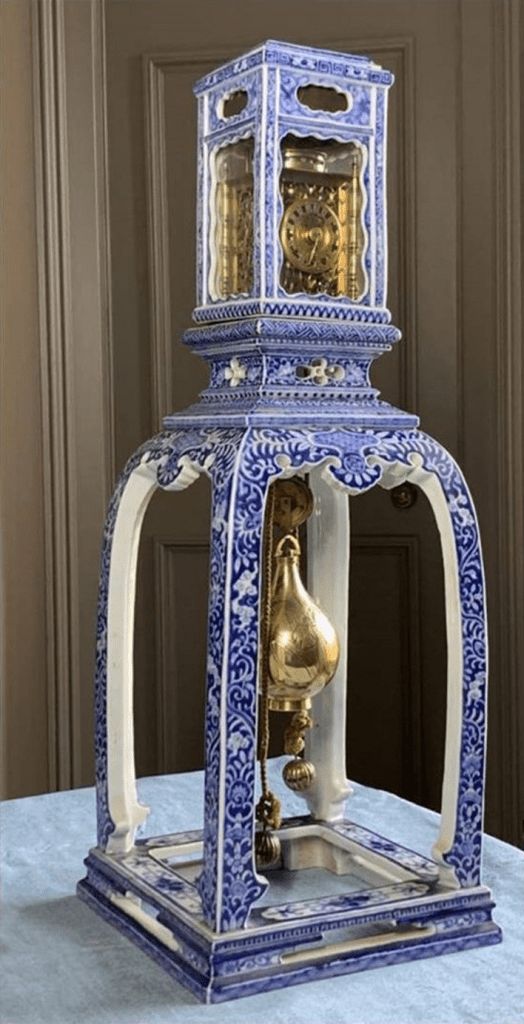
John Drummond Robertson’s ‘missing’ wadokei
14 October 2023 – The Helical Clockwork of Charles & Joseph MacDowall by Angus Bell & Kenneth Cobb – Scottish Branch Meeting Report
In October we had a presentation by Angus Bell & Kenneth Cobb on ‘The Helical Clockwork of Charles & Joseph MacDowall’. I had met Angus at an AHS meeting in Carlisle and we had discussed each other’s interests in horology. I had never heard of the MacDowalls or helically geared clocks. Angus kindly agreed to give the branch a talk about them, even volunteering his friend Ken to take part. It proved to be a very good talk indeed.
Angus started by describing a clock that he had seen in Yorkshire Museum. It dated from 1831 and was engraved ‘J MacDowall Leeds’ It is a month running 2 handed long case clock. The seconds hand being quite conventional but the other was very unusual. It has a 12 hour sweep but between each hour marker there is an arrangement of 59 dots arranged in a vernier like pattern. Thus you could read each minute from the one hand. Albeit you need to be very close to see the dots.
Piqued with interest to know more he met up with Kenneth Cobb and the talk was based on their investigative work over the past 10 years. We were taken through the details of the MacDowall Patent Helix Lever. The use of helical gearing reduced the number of wheels required to make a clock. I did not immediately grasp why until much later in the talk. I was more struck by the beauty of the helical cut wheels and the pinions which were now spiral cut groves in relatively thick arbors. The history of the various MacDowell Partnerships and many workshop moves over their period together was laid out. Several clocks were shown and a very fine example had been brought to the meeting running throughout the afternoon.
In good tag team fashion Ken then took over just as we thought we knew all about it. Ken had clearly deeply dived into the mechanical engineering aspects of the gearing and with the aid of diagrams took us through the ins and outs of single start pinions, Velocity ratios, Rolling point of contacts, and small but not zero pressure angles. As the theory was sinking in he went on to described how he thought such wheels and pinions were produced back then. He had tried to reproduce both himself. The pinions were the harder parts to get right. Any defect produced a variation in the power transmitted and would affect the rate of the clock. Clearly the MacDowalls had perfected their creation.
It was about then it dawned on me that a single start pinion acted as if it were a single leaf conventional pinion. Thus there was a 6 or more times increase in gear ratio and hence the lower wheel count. It took me a while but I got there. There are, of course, tradeoffs in the approach other than the engineering perfection required. Considerable side thrust is generated and this will push the plates apart. All the clocks shown had very thick plates to compensate. There also had to be thrust washers, or other bearings to cope.
Sadly neither MacDowall achieved great commercial success. Partnerships ended and insolvency occurred. Joseph MacDowall, in particular, seems to be lost to history. Angus and Ken are keen to correct this and have formed a 2 man appreciation society to record his horological achievements. My greatest thanks to both for their time in producing and giving a superb talk.
Richard Thomson, Secretary Scottish Branch.
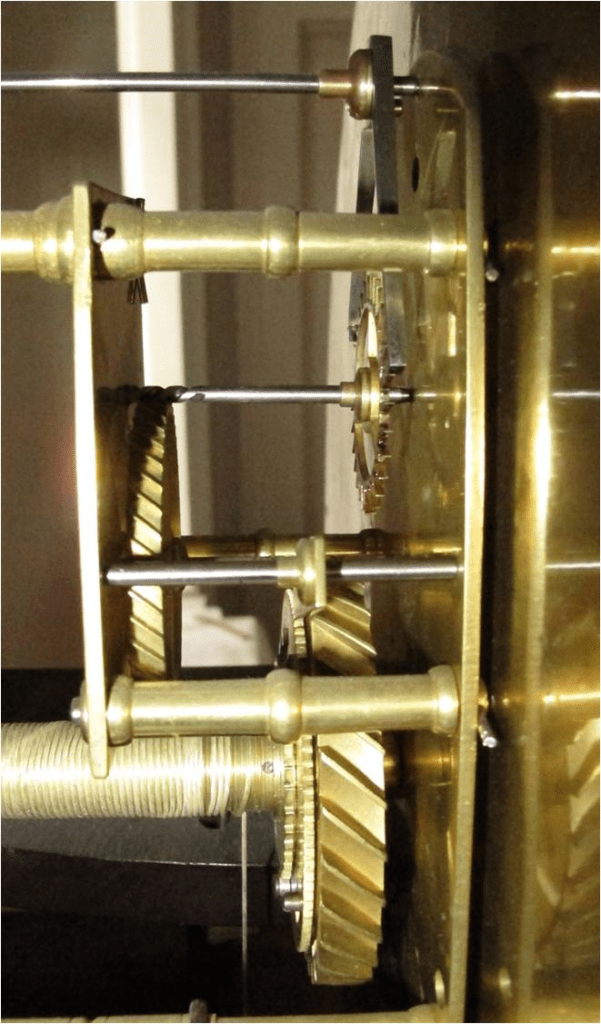
Joseph MacDowall 30 day movement. Circa 1831
9 September 2023 – AGM followed by a ‘bring and discuss’.
Scottish Branch Meeting Report 09/09/2023
In September we had our Annual General Meeting followed by a ‘Bring and Discuss’. There is nothing like the first cold winds of autumn to signal the start of the meeting season after the summer break. So it was with some surprise that it was one of the hottest days of the year. 15 members braved the heat and another 3 joined us online.
The AGM part of the meeting then followed without much ado. We have survived financially; we had a good program of events last season and full program this season. Sadly, however, our chairman Matthew Richards will have to step down this year as his work abroad means that he cannot be in Edinburgh. We thank Matthew for his 15 years of support first as vice chair and then as chairman of the branch. We thus skipped the usual reappointment of committee members and instead deferred elections until nominations had been received from the membership for new office holders.
I kicked off the ‘Bring and Discuss’ event. I have been delving into a wayward knife edge suspension setup and was keen to gain pearls of wisdom from the members. I hope to be able to provide an update at the next B&D claiming unprecedented success. I can but hope. Alastair Walker then produced two tools that he had found over the summer. The ‘mystery object’ turned out to be a very early stapler that used plain brass wire to staple paper together.
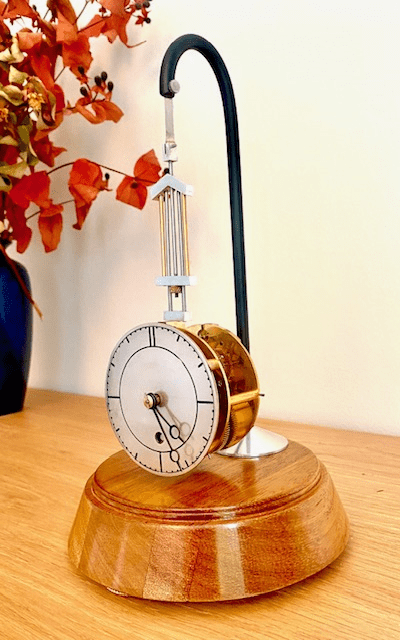
Continuing the theme of mysteries Duncan Massie brought along a mystery clock that he had made. He had turned an old French movement into its own pendulum. It was suspended from a temperature compensated metal support, covered by a glass dome all sitting on a turned wooden base. The overall effect was very pleasing to the eye.
I have often looked at painted long case clock dials and thought that silvered brass would be nicer. Shame on me as Peter Mehta produced two examples of painted Scottish dials and explained the stories behind the scenes depicted. One was based on a Sir Walter Scott poem “The lady of the Lake” that went ‘viral’ back in 1810. It made the Trossachs region of Scotland a tourist hotspot which continues to this day. I will never again be such a philistine.
Zen Chowaniec gave a presentation on train counting techniques with some worked examples. He explained the usefulness of going through this exercise when carrying out repairs. Not the least of which is knowing what to expect to see on the clock timer when testing. As he has discovered not all clocks come with the correct pendulum and not all platform escapements run at 18,000 bph.
New member, Angus Bell, brought along a James Brown of Elgin long case movement. It was a rare example of a 40 hour Scottish clock. It was a good introduction to the group as he and Kenneth Cobb are giving next months talk on MacDowell Helical Clockwork. Last, but not least, Frank Di’Carlo updated us on his Eureka clock restoration project. This time he has been making new contact sets. Much discussion ensued on how to temper very thin spring steel. Any tips on how to punch 5 thou spring steel cleanly would be appreciated.
As ever this report doesn’t do justice to the content presented but it was a full and fascinating afternoon. My greatest thanks to all who attended and took part.
Richard Thomson, Secretary Scottish Branch.
13-May-23 Canon’s Gait Scotland Watch Co, Now and Future by Tomek Borkowy & Colin Graham
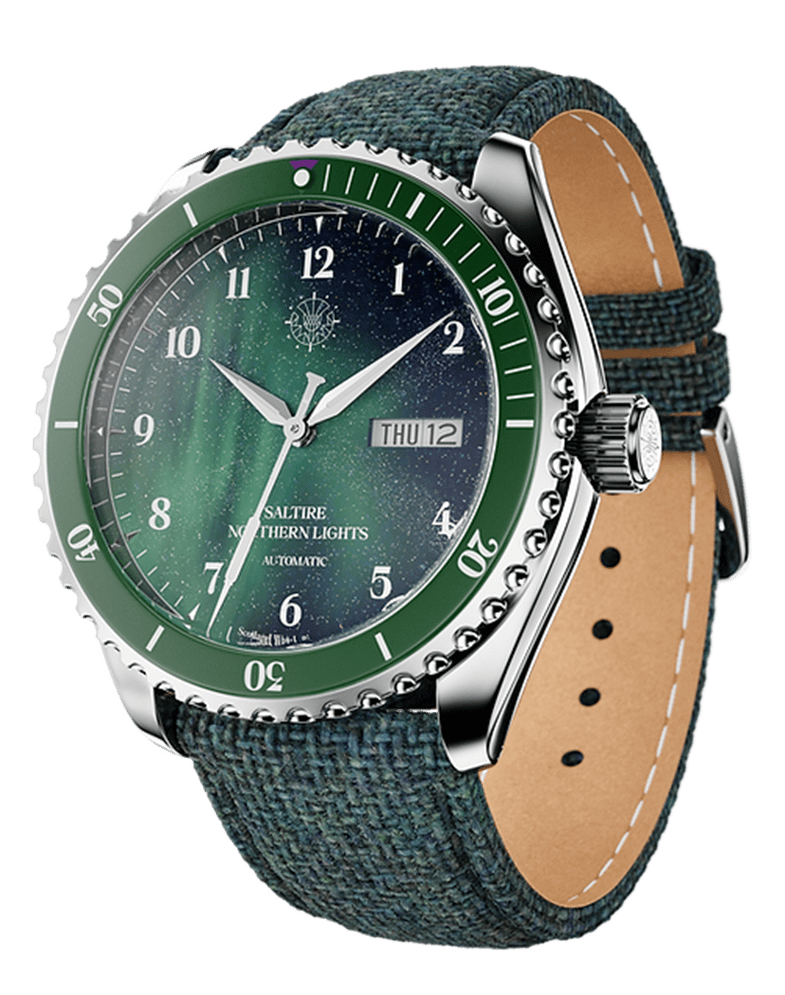
Our final meeting of the season was a presentation by two branch members, Tomek Borkowy and Colin Graham. Together along with a third partner they have established the Scotland Watch Company www.scotlandwatchco.scot
Their aim is to make a range of classic watches with a Scottish theme.
The nature of what is Scottish is challenging to define. Just a few hundred meters in any direction from our meeting venue in central Edinburgh you are bombarded with ‘Scottish’ tat. Scottie dogs with tartan coats and Tartan Tam O’Shanter hats with built in ginger wigs being typical. We could debate all day if this is what is produced to meet demand or a Victorian marketing idea taken to extremes. Either way we can relax as this is far from their product concept.
The 3 designs currently being produced draw from more natural phenomena to be observed in Scotland with a hint of the Saltire flag and a nod to the national flower and musical instrument associated with our fine land. The initial watches are designed around Seiko movements and cased in China. The dials are hand painted and one of the strap options is made from leather backed Scottish Tweed.
Ambition is not short on the ground and they have a strong desire to move some aspects of later model production to Scotland. With more locally made content. There is a little artisan watch making in Scotland but not enough. They want to establish an education program to entice youngsters into horology. This is turn needs training places, apprenticeships, and a realistic chance of making a living. Ambitious indeed but horology does need new blood and AI is poised to decimate many traditional careers so we wish them well.
We were able to see prototype timepieces and limited production is underway. Finance is being generated by crowd funding for those that want to acquire at an early bird discount.
I, for one, will keenly follow their progress over the next few years.
Richard Thomson
Branch Secretary
08-Apr-23 Canon’s Gait Herman Aron Clocks and Inventions by Richard Thomson
The presentation was given by Richard Thomson our Branch Secretary, the subject being an interesting clock he had bought on eBay.
His interest was piqued, as it was advertised as an 1885 electric wall clock (Vienna Regulator style) powered by 200 Volts DC.
When the clock arrived, it’s case was literally in pieces, no glazing and a faulty motor i.e. the copper wires on the surface were damaged and the coil was open circuit.
The clock was labelled as a Dr Aron’s system, Serial Number 110.
As you will know, when electrical power was first introduced, there was the option of Alternating or Direct Current supplies available. Alternating current became the standard as it is easier to distribute over long distances with minimum losses. However, many ships, factories and small towns were powered with DC until the middle of the last century.
This clock is a fairly conventional anchor escapement pendulum clock save for a quarter turn motor to rewind the Remontoire spring every few minutes.
Richard, rebuilt and re-glazed the case then rewound the motor to run from a 12 Volt dc power supply. Having completed the clock he decided to research Dr Aron.
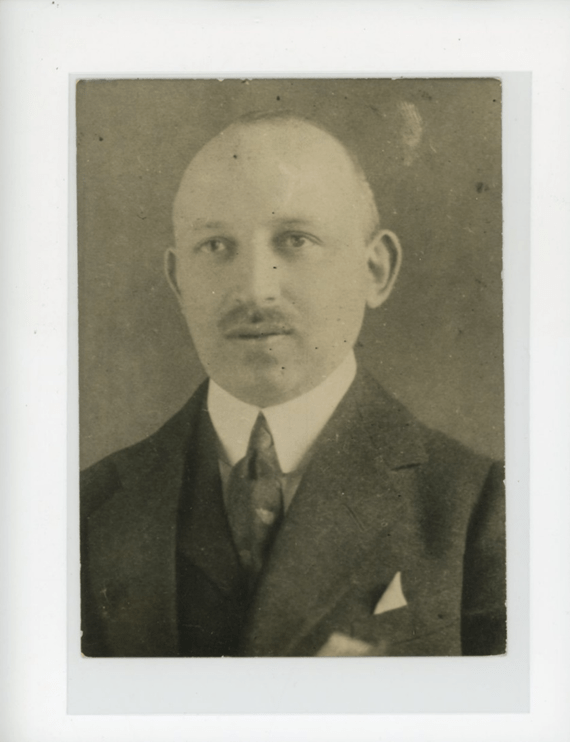
Herman Aron was born in 1845 in Kempten Prussia, modern day Poland. Wealthy relatives helped his education and he went to the University of Berlin in 1867. He studied medicine for the first two terms, but changed to Natural Sciences and Mathematics in his third term. From 1870 he studied at the University of Heidelberg with notables such as Helmholtz and Kirchhoff. He obtained his doctorate from Berlin in 1873 and worked at the physical laboratory of the trade academy. He became a teacher of Physics in Berlin. He also taught at the Prussian Army school for artillery and engineers.
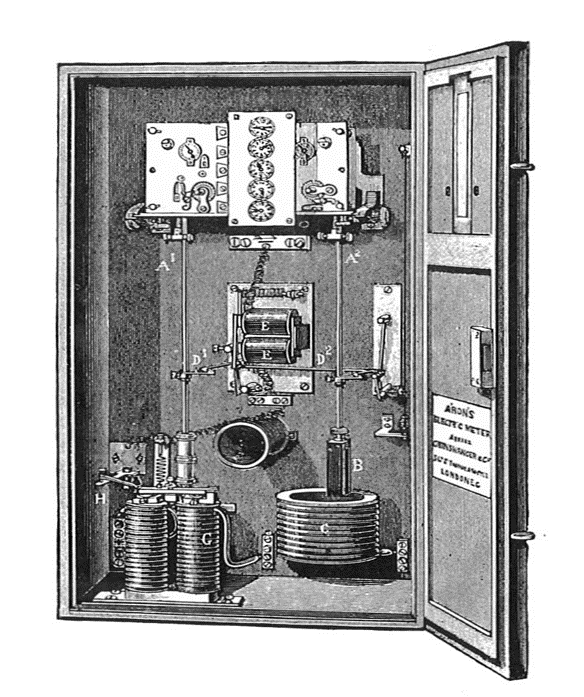
He patented the first accurate Watt Hour Meter. It contained two pendulum clocks, with coils around the bobs. One was accelerated and the other slowed in proportion to the current used. A differential gear mechanism measured the difference in rate between the two clocks and counted this on a series of dials. The first meters used clockwork clocks that required (monthly) manual winding. Later models were self-winding by electricity. The motor developed for this being the same as in the clock above.
These meters were introduced into the UK in 1888 and manufactured and sold by GEC.
He also invented a circuit for measuring total power in a three phase ac circuit, while requiring only two direct measurements of power. These inventions resulted in factories in Paris, London, Vienna and Silesia, employing over 1,000 people.
He also patented the type of lead acid battery used in vehicles to this day and mercury batteries still used in some hearing aids.
After his death his family continued the business, changing the company name several times. In the early 1930’s the company’s main product was radio sets, employing 3,000 people. The family recognised the dangers of anti-Semitism in Germany and sold the business in 1935 fleeing to the USA.
The business he started finally closed in 1996.
A very interesting afternoon.
Frank DiCarlo
Branch Treasurer
Photographs below are of Dr H. Aron and the Watt Hour Meter as patented
11-Mar-23 Canon’s Gait 4/5 Glass Eureka Case by Frank Di’Carlo
The March meeting was “4/5 Glass Eureka Case” by our treasurer Frank DiCarlo.
The Eureka clock was invented by Timothy Bernard Powers in New York just after the turn of the century. They were made by The Eureka Clock Company in Clerkenwell, London between 1908 and 1914. They were, however, not a great commercial success. Probably in part due to their very high cost and poor timekeeping. The 10,000 or so made still remain popular with clockcollectors because the large moving balance wheel is interesting to watch.
Several case styles were offered from ‘Cromwellian’ to a simple glass dome. The 5 glass Mahogany style possibly being the most popular. When Frank acquired his movement he determined to use his woodworking skills to recreate the 5 glass design to house it. Moreover he aimed to make it indistinguishable from an original. This would mean sourcing real Mahogany. (Now a protected hardwood.) Using animal glue in the joints and sourcing bevelled glass to match the original.
There are 33 wooden parts in the case and Frank explained how each was made. Samples of the pieces and some tools used were passed round the room. A reference model at Upton Hall was measured to be sure of the fine detail. Not content with making the case he made a ‘practice case’ first to validate the construction technique. His working tolerance being only 0.1 mm. The Mahogany is finished with French Polish. The stages of sanding, grain filling, staining, polishing, curing, sanding again for at least 10 coats then a final burnish shows a remarkable attention to detail.
Although well down the road to completion this is a work in progress. There is still much restoration to do on the movement. I’m certain that the finished result will be a masterpiece. I hope that he will bring it to be admired at a future meeting. The branch extends it thanks to Frank for his comprehensive coverage of the case build, movement operation and history.
Richard Thomson
Branch Sec.
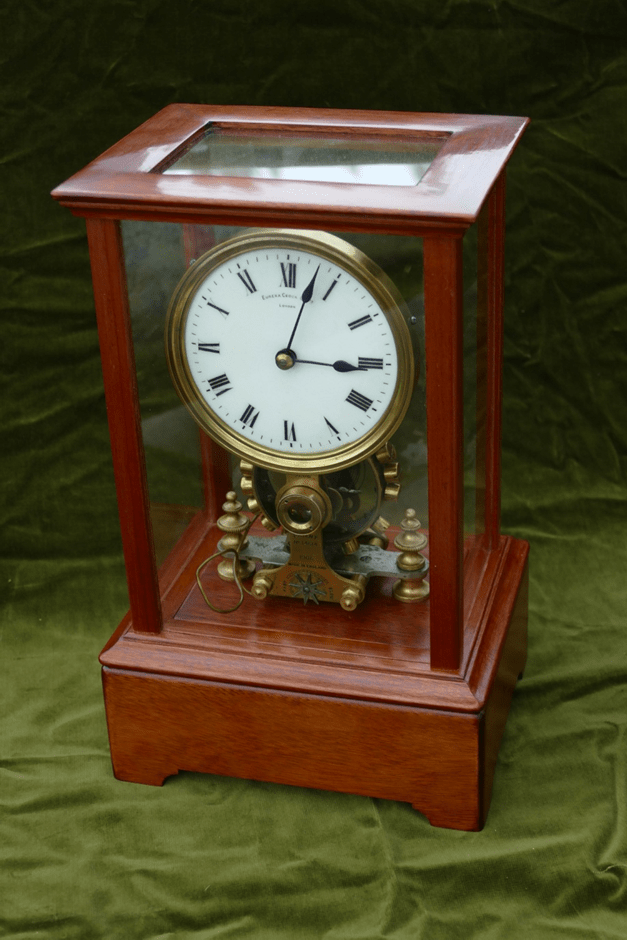
Franks Eureka un-restored in its practise case with plain glass
11-Feb-23 Canon’s Gait Restoring Turret Clocks by Duncan Massie
The February meeting was “Turret Clock Restoration” by Duncan Massie. This was the third in his series to the branch. The first in Jan 05, then Dec 15, and now Feb 23. Only one current member remembered the original 18 years ago so it was high time to recover the ground and get updated on projects since. Good to say that the subject of the first talk, as Hospital House, was still running well. In no small part due to the fact that Duncan was still the clock keeper and responsible for the weekly winding. Duncan showed us before and after images of the clock during the restoration process. It was built in 1858 by Simmons of Warwick. It probably ran for 100 years before sitting idle for 50 years before restoration. It was more corroded by bird droppings than worn-out by use.
The second clock described by Duncan was in Blackcraig Castle. Again, by Simmons but of a very different construction. It showed little signs of wear but plenty of woodworm in the wood used to form the hubs of the cable drums. It was good to see how well the various parts responded to a bit of TLC to look like new. However, Duncan’s work was cut out by having to repair damage caused by the handling of the movement by the workmen rebuilding the Castle. The first clock consisted of a beautiful cast iron frame. The various arbours were held in place by straps running top to bottom on the side of the frame. These housed the bushing held in place by screws. The second clock was a more familiar two plate design. Albeit at a grand scale. Sadly the pillars needed to be replaced as they had been broken, the flys were broken and the remains of the weight cables were just a rusted mass around the drums. Again, the before and after images were stunning.
The third clock discussed was Duncan’s own movement. It was of a third different construction method. It was made by James W Benson of Ludgate Hill. Dated mid to late 1800s is consists of a cast base onto which are attached substantial other castings to support the arbours. This makes it easier to remove and repair a small part of the mechanism if required. Again it is a remarkable before and after transformation. Some of the missing parts had to be recreated by reference to a Benson catalogue where it was described as a ‘modern’ turret clock.
The branch extends it thanks to Duncan for a great trilogy and can we possibly book you in for another update around 2030?
Richard Thomson
Branch Sec.
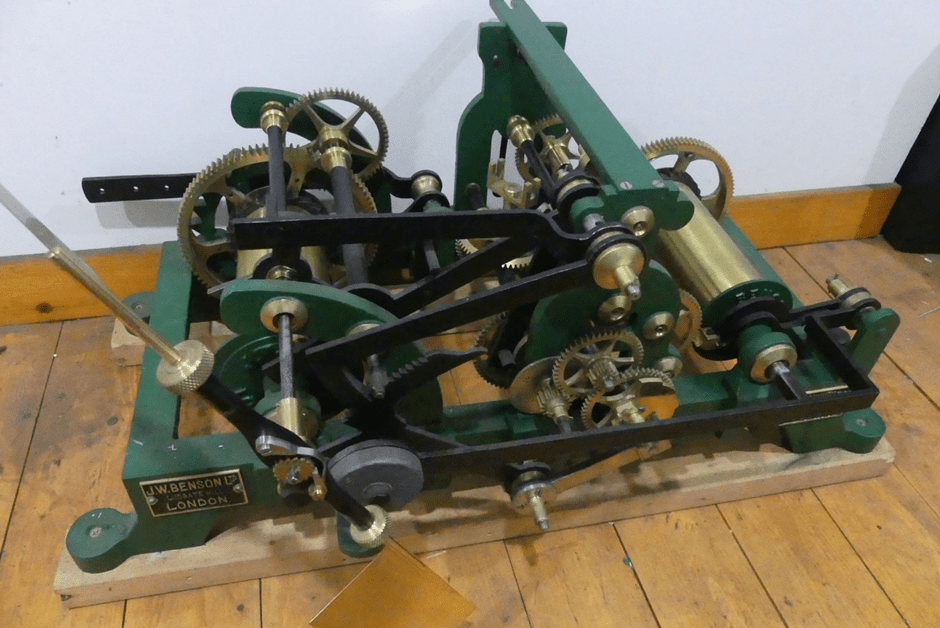
Duncan’s Own fully restored James W Benson Clock
14-Jan-23 Canon’s Gait Bring & Discuss
The first meeting of the year was a Bring & Discuss event. These are always interesting with a wide variety of topics covered by the speakers. If I was to find a common theme this time it would not be repair techniques or technology. It would be the realisation that these old mechanisms that we cherish were conceived and crafted by individuals earning their living. Not a mass produced ‘one of many’.
The first 3 speakers, Alastair Walker, Arthur Jones and Zen Chowaniec all gave examples of this. Alastair had an unusual French clock mechanism with a balance wheel escapement in place of the more normal pendulum at this time. This was neither a modification nor a platform escapement module but a ground up design. Clearly someone had conceived this and made it. Alas no idea how successful it was in operation. Arthur’s example was a clock that he had in for repair. It was made in Edinburgh by James Donaldson and still owned by a descendant of his. This is relevant when the dial is viewed as it can be seen to be mis-painted in that the numbers are offset. The 9 is lower than the 3. The 12 is left of the 6. This can only be a ‘second’ quality item and must have been used for his own clock as he would not have been able to sell it. Again, very human. Zen’s example was a Lewis Donne regulator clock. Lewis Donne (1838 – 1918) was the fifth generation of Donne clockmakers and probably the best known and most successful. It is a beautiful mahogany wall regulator with mercurial pendulum and hidden weight. It oozes quality and was made to the highest standards. The clock has a deadbeat escapement with Harrison’s maintaining power. The movement alone weighs in at 8lbs. However, strangely, there is no provision for fine beat adjustment other than shimming the movement and / or adjusting the position of the case on the wall. It is intriguing to conjecture why Lewis Donne decided to make no provision for this adjustment.
Such are the interesting tales to be discovered when working on items made by individuals at any budget level.
Our thanks as always to all those who took part, asked questions, past comments and joined online from around Europe for an enjoyable meeting.
Richard Thomson
Branch Sec.
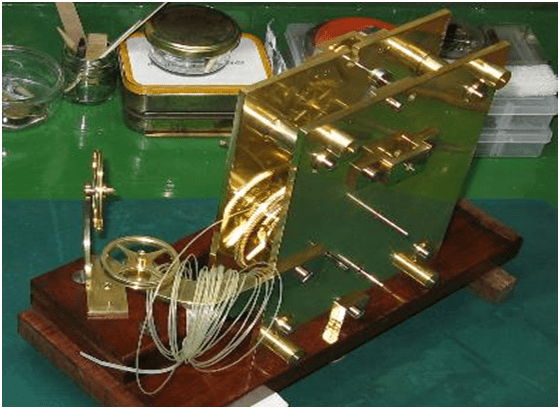
10-Dec-22 Branch Christmas Lunch 1PM at Giulianos 18-19 Union Pl, Edin, EH13NQ
12-Nov-22 Canon’s Gate “Restoration of a 200 year-old Japanese Temporal Time Lantern Clock” by Ashley Strachan
In November we returned to our old venue to see the newly refurbished pub and meeting room. We had a good turnout of members which had nothing to do with the availability of beer and food. It was down to our speaker Ashley Strachan. Our past chairman has always given good presentations and this one was right at the top. “Restoration of a 200 year-old Japanese Temporal Time Lantern Clock”
For many years he has had a particular interest in Japanese Bonsai, subject of a previous talk, and wadokei. (Japanese clocks of 1549 – 1872) He stated off by giving us a crash course in the clock history of Japan starting with the very first in 1549. It was a gift to the Emperor from a Jesuit missionary. The oldest surviving clock dates from 1581. Shortly afterwards Japan closed its borders and became cut off from European developments from the like of Huygens, Tompion, Harrison, Lapine et al and went down their own path of development.
Culturally they defined the day as six ‘hours’ of daylight and 6 of darkness. Thus each hours duration had to vary over the seasons to be correct. This temporal time requirement brought some technically fascinating solutions to the fore to make a working clock. One particular solution used two foliot escapements. One for the day rate and one for night with a changeover mechanism at dawn and dusk. The results were always a compromise and ‘Clock Doctors’ were required every 2 weeks to adjust the foliots. It is one of these wadokei that Ashley has acquired and restored.
His rare yagura-dokei (clock on pyramid stand) was more earthquake resistant than some on narrower based stands. However it was missing a few key parts and some other bits were broken. Many of the parts were recreated using simple files and other hand tools just as the original makers must have done. Aside from two foliots and changeover mechanism plus a date wheel it has the added complication of chimes. Another peculiarity of the wadokei as the chimes are arranged in a 9-1-8-2-7-1-6-2-5-1-4-2 sequence. 9 strikes at noon down to 6 at dusk with a single strike at half past an odd hour and two strikes half past an even hour. Four hour strikes were the least returning to 9 at midnight.
Ashley had his restored clock with him for us to examine after his talk. With two new foliots, replacements for the missing cams and levers, bell hammer and even a new traditional bell nut.
Our greatest thanks to Ashley for his excellent talk, insight into this culturally driven horological cul-de-sac, and the many hours he must have spent producing some of the finest PowerPoint slides ever shown.
Richard Thomson, Secretary Scottish Branch
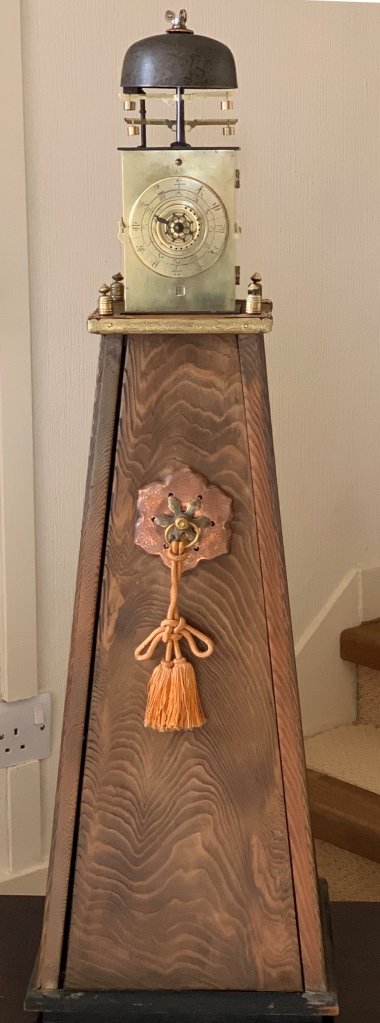
yagura-dokei
Scottish Branch Meeting Report 8/10/2022
In October we had to have a change of program. The rail strike made travel into Edinburgh difficult so we had a virtual ‘Bring and Discuss’. The scheduled talk by Ashley Strachan will now take place next month.
The programme commenced with Zen Chowaniec making another great contribution with four examples of his workshop activities. The first was a cautionary tale caused by a mainspring clamp failure. Fortunately without injury but it emphasised the need to be vigilant of the potential dangers. There is a lot of energy stored in a fully wound spring let alone it being sharp. The need to wear PPE, gloves, eye protection etc, is all too plain. Not just when using springs but any cutting and grinding operation calls for eye protection as a minimum.
Less terrifyingly he went on to describe a clock in for repair that was found to be a marriage between a very attractive movement and slate case. Alas the case was not tall enough for the required length of pendulum. By analysing the wheel count the correct length could be surmised and a solution was found that met with the customers’ approval. A hardwood plinth was made to elevate the clock so that the extra length could be accommodated.
Next up was a Postmans Alarm Clock. Again in need of a pendulum of the correct length as well as a new escape wheel tooth. One item in the following discussion was did anyone know why the dials are often a pink hue. Is it just easier to read than a white dial? Answers please.
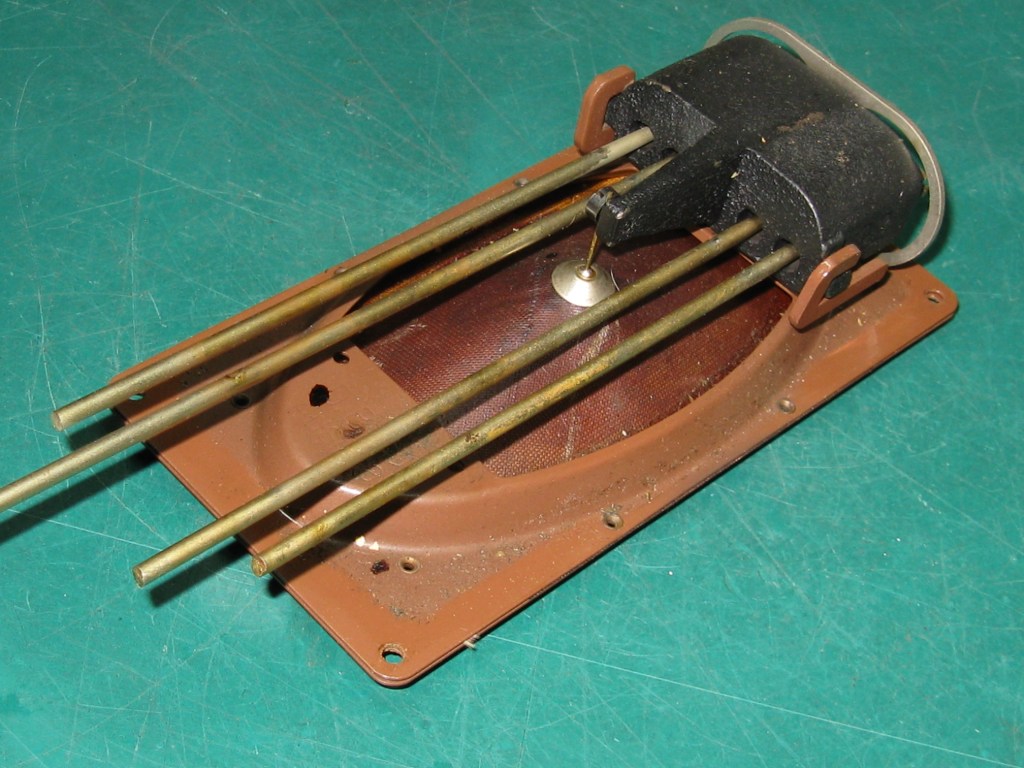
Lastly he presented an oddity not seen before and that was a HAC three train clock with the expected chimes. What was unusual was a mechanical loudspeaker added to the gong rods to amplify the sound. (HAC Acoustic ?) Does anyone know the story behind this, short lived, development? Pictured below.
Then it was my turn, and I did my best to prove that Zen is a hard act to follow. However I quickly described my 3rd clock purchase this year after my self-imposed ban on more clocks. I then went on to describe a series of practical tests to find a better interface to my Mumford Micro Systems Microset timer. The need to be able to remotely time a pendulum clock with a visible pendulum was brought about after I discovered a four seconds per day rate change by simply opening the glass door. The solution being a cheap optical sensor using an LED laser as light source. This simply has to be pointed at a suitable part of the pendulum from several feet away. It compares favourably to the stock slotted optocoupler.
My thanks to Zen and all questioners for an interesting afternoon.
Richard Thomson, Secretary Scottish Branch
10th September, 2022 AGM & Bring and Discuss
In September we had our Annual General Meeting followed by a ‘Bring and Discuss’. Last year it had to be held virtually. This year it was going to be in-person with a feeling of celebration from getting through a difficult two years. Alas our venue is in the shadow of Holyrood Palace which was now, regretfully, one of the centres of world attention. The surrounding roads were closed and the streets filled with crowds wishing to be close to the Palace and share in sorrow. Our meeting started with a minutes silence from those who made it to the venue.
The AGM part of the meeting then followed without much ado. We have survived financially, we had a good program of events last season and all committee members were re-elected. We discussed potential improvements to the social side of the group including the re-introduction of a pre-meeting lunch. Much encouraged by the fact that our favourite watering hole has reopened.
Alastair Walker took the honour of being our first speaker in the ‘Bring and Discuss’ event. He had recently repaired a clock with a ‘Mis-en-Marche’ (A lever to start a clock without moving it when the pendulum is inaccessible.) This was compared with the Scottish method of mounting the clock with a shoogly nail. He also showed a year going clock with a perpetual calendar that he has acquired. Photograph below. One of its oddities is that it has 5 spring barrels and only one winder. At least two are geared together in parallel. We look forward to an update with pictures showing the full mechanism.
I then took over and talked about two new clocks that had come my way since I had said that I had enough clocks and wasn’t going to buy any more. I hopefully justified my purchases by explaining the uniqueness of my finds and how entirely different my latest Synchronome is to my others. One of its characteristics is that it was one of the few with a white painted dial. This was a feature in the mid 1920s when there was a shortage of the engraved, silvered dials used before and since. One reason for their short appearance was that the paint would flake off the zinc plated metal base. Mine is a gross example. I picked the members brains for advice on how best to conserve the dial now that it is in this state. A front runner at the moment is to coat the dial with some clear shellac to bond it together. I will research the various options and see if I have the courage to try.
Peter Mehta rounded off the afternoon with the research he had done into the origins of a long case clock that he has recently serviced. An apt title would have been: In search of Raes Land. The clock had been signed by William Ballantyne whose workshop was in Raes Land just a few hundred meters from the meeting venue. Or back then a furlong or so. (Incidentally a furlong was originally the distance that an Ox could plough without needing a rest. Literally a ‘furrow long’) He was active between 1781 and 1806. Alas none of the buildings from that part of the Royal Mile survive to today. However Peter did manage to find references to Raes Land from around 1700. Sometimes the back story is just more interesting than the clock.
My thanks to all those who took part and lifted our spirits with friendly banter.
Richard Thomson, Secretary Scottish Branch.
14th May 2022 IWC Calibre 71/72 ‘Fishtail’ Pocket Watch Movement’ – Owen Gilchrist (BHI Bristol Branch) (Virtual and the Harry Younger Hall)
Scottish Branch Meeting Report May 2022
“IWC Calibre 71/72 ‘Fishtail’ Pocket Watch Movement”
In May 2022 we were delighted to welcome Owen Gilchrist to the meeting hall. Owen had been recruited to give us a talk pre-Covid. This was postponed until now and not held virtually due to the nature of the presentation. Probably a first in the history of the branch Owen was going to describe his ‘Fishtail’ movement by building it in front of us. The parts were brought to the hall in watch part cleaning baskets as if just out of the parts cleaner.
To achieve this Owen also brought a workbench, stool, lights, camera, projector, tools, boxes of spares and other movements to show. Moreover this was all transported from his home near Bristol. He began by describing the movement. Why it was called a ‘Fishtail’ and showing off some of its unique features. It is one of only 1200 of its type produced by IWC and is now over 100 years old. The finish on the parts was exemplary. It was noted that the finish on the escape wheel was different to the others. This had to be for a reason, possibly an indication of it being made with antimagnetic properties.
All parts of the movement carry the last few digits of a common serial number so we can be sure that the parts were all original. The movement also bore 3 IWC patent numbers. Owen has researched these and was amused to find that the features described did not actually all appear in the movement.
Assembly commenced to a hushed audience. So quiet that you could hear a pallet fork drop, also ably demonstrated. This was quickly recovered and the rest of the process continued without incident. I know how hard it can be to assemble anything let alone with an audience. Owens 1000s of previous watch services obviously helped. After demonstrating the completed movement on a watch timer, and many questions, members were able to crowd round and look at some of the other examples brought to the meeting.
The photograph shows members queuing to get a closer look at some of the other movements after the demonstration.
The branch extends its greatest thanks to Owen for such an enjoyable, unique, afternoon.
This was the last meeting in our 21/22 season. The season marked our return to meeting in person, at a new hall, and with a great variety of speakers and topics. Our next meeting will be In September 22 with our AGM followed by a ‘bring and discuss’.
Richard Thomson
Branch Secretary.
secretary.bhi.scotland@gmail.com
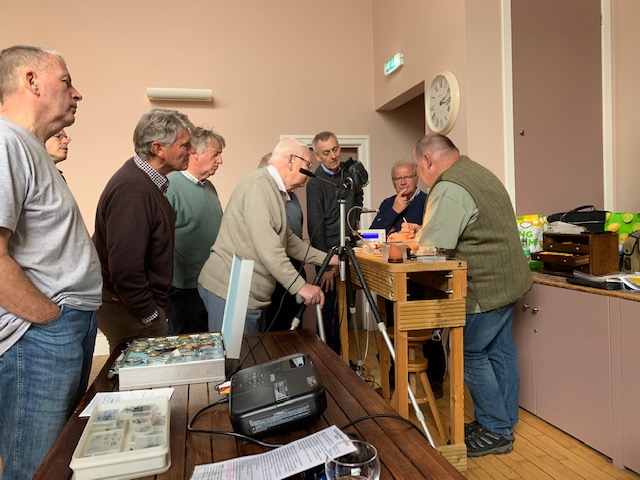
9th April 2022 Ritchie Clocks – Eddy Odell (Professor of oral pathology and medicine KCL) (Virtual and the Harry Younger Hall)
“Ritchie Clocks and the Edinburgh Ring”
In April 2022 we were delighted to welcome Eddy Odell to the meeting hall. When Eddy was asked to give a talk to the branch he was worried that we would know all about his subject. That was very far from the truth. After his talk we knew a lot more but were probably only exposed to a fraction of Eddy’s research.
First founded in 1809 by James Ritchie the company produced turret clocks and sold watches and jewellery. By 1840 the use of electricity in clocks was taking hold and Ritchie’s became leaders in the field. No doubt aided by their family friendships with Alexander Bain – a genius who started life as a shepherd in Caithness, invented the first electric clock and the principles of telegraphy and faxing machines – and Alexander Graham Bell, inventor of the telephone. On his death in 1849, the business was taken over by a son, Frederick Ritchie.
The time ball above the Nelson Monument on Calton Hill in Edinburgh and the time gun at Edinburgh Castle are two of the most famous time signals in the world. The time ball was erected under the leadership of Professor Charles Piazzi Smyth. It became an official signal in March 1854. From the outset, the ball was released by an electric telegraph signal from a clock at the nearby Royal Observatory. The time gun on Edinburgh Castle was introduced in 1861, with automatic firing by a Castle clock that was synchronised by electric telegraph from the Observatory. Frederick made important contributions to the accuracy of both time signals. ‘Dropped Seconds’ being a feature incorporated in the slaved clocks to allow an observer at the master to check that the slave was still correctly locked to the second.
What few of us knew about was just how extensive the system grew in the next few years. It was possible to lease the correct time and have a clock installed at your premises controlled the same way. The Post Office, The Bank of Scotland, The City Chambers, to name a few, were not only linked to ‘the ring’ but many Ritchie slave clock systems also existed around Edinburgh. Most surprising of all, possibly, was a telegraph link to synchronise a time canon in Dundee from Edinburgh.
Very little is known about the whereabouts of any of the original master clocks or slaves. There were possibly some hundreds of items. Eddy would like to track down as many as possible. Alas they were not to a common design but all will have some common DNA about them. Below are 3 pictures which could act as a reference. A pendulum with a bob of coiled wire over a laminated magnet. A movement with unusual contacts. Probably a 4 digit serial number and possibly the emblem with lightning flashes. If anyone wishes to contact me with details I will gladly pass them on.
The branch extends its greatest thanks to Eddy for such an enjoyable, information packed, afternoon.
Richard Thomson
Branch Secretary
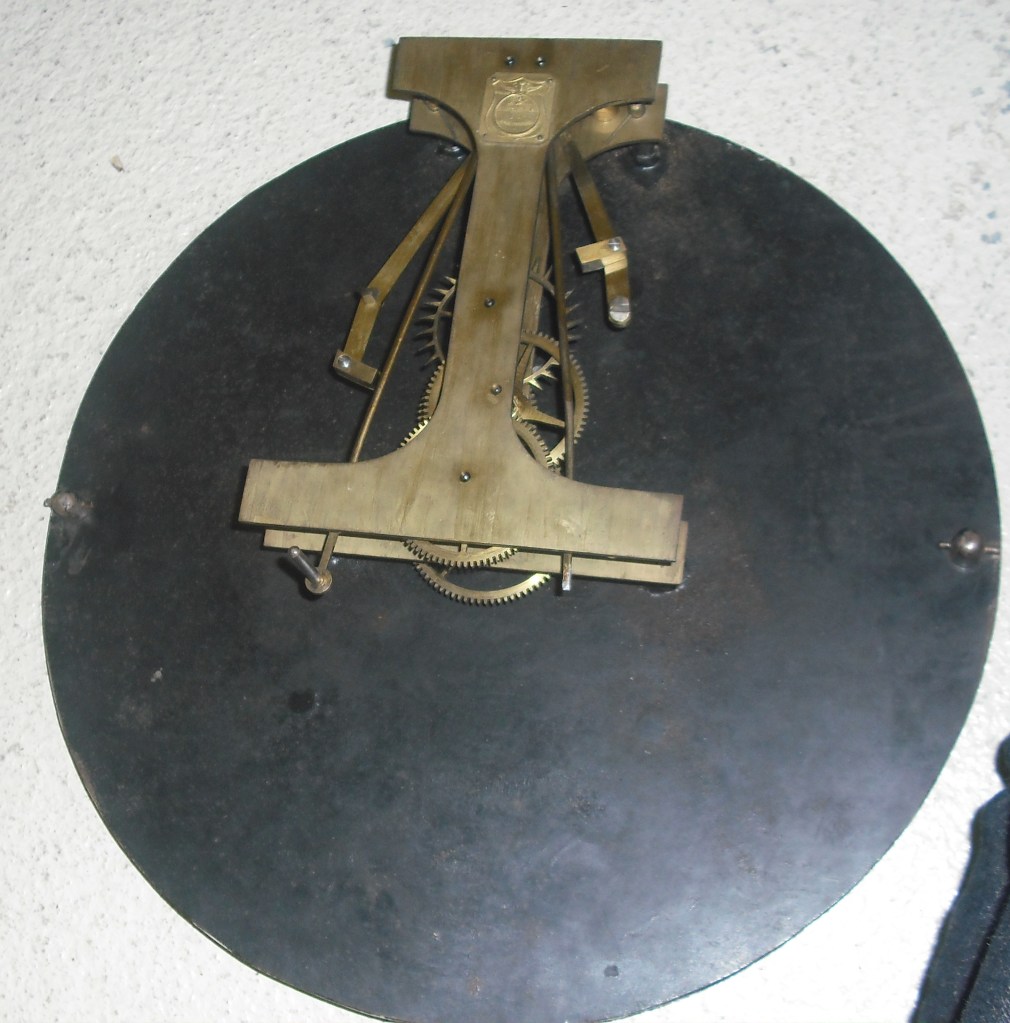
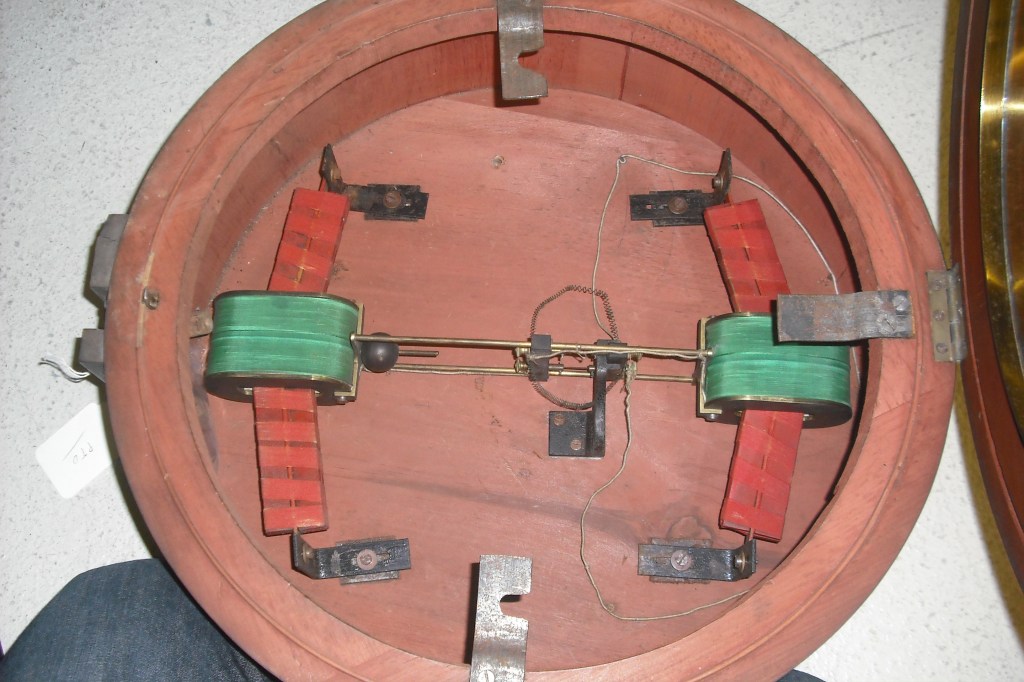
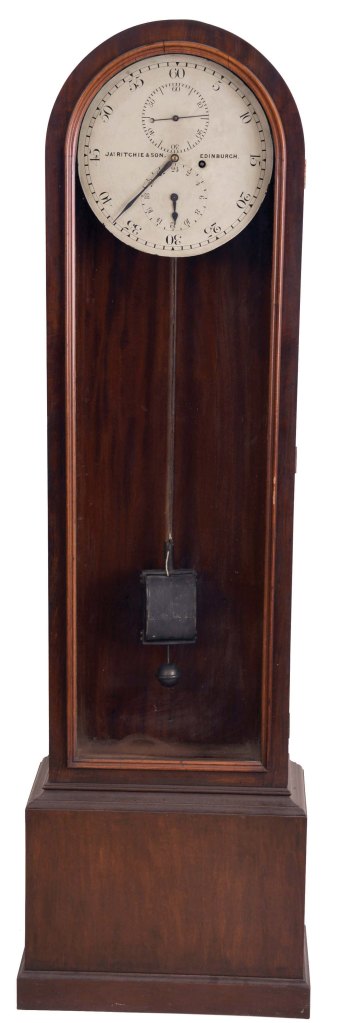
12th March 2022 ‘Swing Time – Making a Wooden Pendulum Clock’ (Harry Younger Hall) – George Johnston
In March 2022 we were delighted to welcome George Johnston to the meeting hall. George’s talk had been postponed due to the Covid19 Lockdowns. He had requested not to present online as we would miss out on seeing his project clocks in person. I am delighted that we agreed as it was well worth the wait.
He brought two quality wooden clocks of different designs with him. These were set up on a side table. Rarely has a speaker been unable to start his talk due to the oohs and aahs and rapid fire questions from the branch members. Finally after a few “I’ll get to that in my talk” he was able to begin.
Both clocks were based on designs by Clayton Boyer, based in Hawaii. His first is called “Swing Time” and features a 1 second compound pendulum. It is powered by a small geared motor supplied by a hidden 9V battery and tilt switch. The weight of the motor and battery is what drives the clock. This Remontoire is just one of the technical features to raise this clock above the ordinary. Also, the Tic Tac escapement, the frameless construction, the hypocycloidal motion works, the manic 40 degrees of pendulum swing. Not forgetting the tick. The evenness of which is testament to the precision of all the hand cut wheels.
The second clock is called “Deco” after Art Deco. This time it is spring powered with a more conventional ½ second pendulum, anchor escapement, wheels, pinions, frames, but so attractive by the colours of the woods used and quality of finish. At 17 inches high with a 12 inch dial it is a head turner.
The material of choice for most of the parts was a good quality 12mm Birch plywood. George played a video of him cutting a pair of wheels using a sander and a bandsaw. The crossing out performed with a scrollsaw. George did admit that it took a few weeks of fettling to perfect their reliable operation.
The presentation finished with a demonstration of both clocks running and numerous questions on wood choice, finishing, sanding, lubrication and much more.
The branch extends its greatest thanks to George for his time and effort in producing a memorable demonstration of craftsmanship.
Richard Thomson
Branch Secretary.
12th February 2022 The Binns Clock (Virtual and the Harry Younger Hall) – Mark Crangle (Cumbria Clock Co)
In February 2022 we had our first, in-person meeting for 2 years. We hope that this will now be the norm. It was also our first meeting in our new meeting hall just off Edinburgh’s ‘Royal Mile’. It was well attended with the new hall offering space to distance, and with members adopting masks, it gave a feeling of security.
We were delighted to welcome Mark Crangle of the Cumbria Clock Company. Mark had led the restoration of the ‘Binns’ Clock at the West end of Edinburgh’s Princess Street. A popular landmark since the 1960’s. Binns was a prestigious department store, later owned by the House of Fraser. Mark had done extensive research on the public clocks of Edinburgh and what led up to the commissioning of the new clock.
The new clock came about because of traffic increases at the West End requiring the removal of the original Pillar clock. The roads were redesigned as the old Edinburgh tram system gave way to the Motor car. The clock was paid for by Hugh Fraser at a cost of over £1000. A tidy sum in the 1950s but they did own Harrods back then.
The clock was built by the Synchronome Company of London and its basic structure is a 6 foot by 6 foot cast bronze box placed some 40 feet above the pavement at the corner site. In addition to quarter chimes it was graced by pipers, in highland dress, parading along a circular track at the base of the clock. An unexplained quirk being that these marched to the tunes of “Scotland the Brave”, at 7 mins 36 seconds after the hour and to “Caller Herrin” at 37 minutes 36 seconds. Answers on a postcard please. It was driven by a, still existing, Synchronome master clock with impulse movements for each dial.
The new clock was not universally popular with the locals. Its six lots of musical chimes per hour were considered intrusive and attempts were made to silence the clock. However, its popularity grew and it became a rendezvous point in the days before social media and instant communications. Over the years it was modified as parts wore out and, in its final form, the hands were driven by synchronous motors. The music generator was lost and the paint faded and flaked.
The Edinburgh branch of Frasers is no more and the building is now occupied by the Johnnie Walker whisky experience. They decided to get the clock restored and done in time for St Valentine’s Day 2021. Mark went into detail about the issues the clock had and the restoration process. The photograph shows the restored clock in all its splendour ready for another 60 years.
As a bonus Mark went on to describe some of the work he did on the Westminster ‘Great’ clock. A subject that could fill several afternoons in its own right. The enthusiastic question and answer session covered subjects from tuning bell hammers to experiences abseiling down church towers to overhaul the turret clocks.
The branch extends its greatest thanks to Mark for his generous time and effort in producing a fantastic restart to our in-person program.
Richard Thomson – Branch Secretary
8th January 2022 Bring & Discuss (Virtual)
Scottish Branch Meeting Report January 2022
In January 2022 we had another virtual meeting. A new variant scuppered our plans to meet in person. Fingers crossed for next month.
The meeting was a ‘Bring and Discuss’ always popular and this continued to be the case. It kicked off with a presentation by Zen Chowaniec of tales from his workbench. A Fusee click failure was first up and in Zens normal high standard of presentation I learnt all that I now know about Fusees. This fitted perfectly with Arthur Jones current issues with a Fusee mechanism and discussion ensued about the correct method of setting up a Fusee on rebuild. Zen progressed onto two clocks with different striking faults and how they were diagnosed and repaired.
Next up, Peter Mehta gave us a cautionary tale about the transport of a long case clock mechanism in an open crate. Fortunately Peter had photographed the mechanism before transport and had something to work off when making, from scratch, the now missing parts. The rackstop and a pawl. All credit to Peter as a photograph is a long way off a dimensioned blueprint.
Mark Baird gave us an update on his Rose Engine. He has made considerable progress since November and is now able to do trial engravings. He described the issues to date and pointed out defects in the final engravings. It is thought that this could be down to vibration from the stepper motors. After comments from the group he is off to investigate alternative drive modules and software tweaks for the steppers.
Ken Russell gave an interesting talk on his experiments to produce an automaton shoulder joint that can both raise its arms and swing them to-and-fro. He showed his experimental mechanism and described the various issues encountered. He had hit a wall where the joint failed to produce the fully controlled movements desired. The issues would only get worse when clothing would be added in a final model. After suggestions from the group he may revisit the concept.
The last hour of the meeting was a presentation from Marcus Bowman which started with his uses of plastics in his business. This covered how to machine Nylon (if you really have to) using solid carbide cutters. These were highly polished in an attempt to stop the nylon from grabbing. The tool bits used were borrowed from those normally used for aluminium. He also described using Delron, Corian, Staron and other plastics. He then brought us up to date on 3D printing and the now affordable resin printers. He showed parts he had made with fused filament printing and contrasted them with parts made by his resin printer. The parts all needed some post printing fettling but he was able to make a working anchor escapement. Both the anchor and the escape wheel in resin which could not be done using filament. Indeed he had gone on to make a complete working clock. Balance spring et al. There was a lot of content and information to absorb. Design, slicing, washing, curing, first layer issues software and much more.
The branch extends its thanks to all the contributors for the fascinating afternoon.
Richard Thomson
Branch Secretary.
11th December 2021 The Branch Christmas Lunch was held at Giulianos, 18-19 Union Place, Edinburgh, EH13NQ.
Scottish Branch Meeting Report 13th November 2021
In November 21 we had possibly our last ’Virtual Only’ meeting of this era. In December it is planned to have the branch Christmas dinner and then January’s meeting should be our first In-Person meeting since the pandemic changed everything.
The meeting was a ‘Bring and Discuss’ always popular and this continued to be the case. It kicked off with presentations by two members of their ‘lockdown’ projects. David Walker had made a very good job of his Rokr wooden kit clock. He was full of praise for the quality of the Rokr laser cut parts and the end result is a working clock with around 8 hours duration. He described the finishing of the parts by hand and the staining and waxing used. He also experimented with various lubricants as traditional clock oil would only aid in wetting the timber. There are around 50 kits in the range and were endorsed as being good Christmas gifts.
The second project, by Bill Lomond, was also a wooden clock but of very different design. It used an electrically maintained pendulum and two pawls to drive a gathering wheel similar to a Bulle clock but vertical. Two videos were played of it in operation. Plugged into the national grid continuous operation was possible. There were many fewer parts but they were all hand sawn from planks of timer. Namely Oak and Beech Plywood. Bill explained the need to balance the hands carefully to avoid unintentional gains and losses of time as the hands are free to rotate at most times.
Tomek Borkowy described his ‘Marriage Watches’. These are more common in the USA and Europe than the UK. They originate from the desire to use pocket watch movements whose cases have been melted down. These are turned into unusual wrist watches with glass fronts and backs. Sometimes needing new dials if the movement is rotated 90 degrees for the crown wheel to exit the side. Tomek has built a network of talented crafts people from Bulgaria to China to assist with production.
Mark Baird described his lockdown project, a Rose Engine. Realising that an original Rose Engine was never going to appear by magic in his workshop and not wanting to simply CNC patterns he has opted to make his own. This will however be an updated design where it is possible to use CAD to view the finished pattern before engraving. A large degree of operation will still be done manually but two of the basic degrees of freedom of the work piece will be stepper motor driven. Much effort has gone into using ball screw shafts to reduce backlash to 0.2mm. This is a grand project with many stages still to go. The branch looks forward to future updates.
Our final presentation of the day was Thomas Meine who talked about Timex electric and electronic watches. In their heyday Timex made over a billion watches between 1950 and 1980. Some 133,000 per day average. Very few still survive in collectors condition as there were priced to wear and were replaced when worn-out. At first the battery was just used to replace the power from the mainspring. Later on more electronics were added but they still retained a balance wheel and hairspring. It was simply maintained in motion by electricity. Thus daily winding was superseded by changing the battery after 18 months. This led to the crown wheel being largely hidden or moved to the back. A refinement of this was made by Junghans, a similar concept but with 17 jewels and by Bulova who replaced the balance with a tuning fork.
Richard Thomson
Branch Secretary.
9th October 2021 The Venus Tablets of Ammisaduqa (Virtual) – Bruce Vickery
BHI Scotland Branch Meeting report Saturday 9th Oct 2021 at 2:00 PM
The October meeting was a talk by a long time branch member Dr Bruce Vickery. His subject was “The Venus Tablets of Ammisaduqa” This was the result of many years of original research by him to solve a problem that had troubled academics for over 100 years.
As usual with these things the path into this field was not direct nor necessarily planned the way it turned out. As an interest in retirement Bruce wanted to calculate planetary motion from the known laws of motion. This led to a book Astronomical Algorithms by Jean Meeus. Using his skills in C# he converted the books formulae to code to calculate planetary motion. This was then applied to solve the long standing puzzle.
The Venus tablet of Ammisaduqa is the record of astronomical observations of Venus, as preserved in a cuneiform tablet dating from the second millennium BC. It is believed that this astronomical record was first compiled during the reign of King Ammisaduqa in Babylonia. Thus, the origin of the text is probably dated to around the mid-seventeenth century BC. The tablet recorded the rise times of Venus and its first and last visibility on the horizon before or after sunrise and sunset (the heliacal risings and settings of Venus) in the form of lunar dates. These observations are recorded for a period of 21 years. The task was to find a match between these observations and those calculated from first principles. If a match were to be found, then the 21-year period could be assigned to a start date using today’s Gregorian calendar.
Because of the highly cyclic nature of the orbits involved there were potential solutions every 8 years. The skill was to use statistical analysis to identify which harmonic was the correct one. The satisfying answer was 11th March 1645 BC, probably.
As a side note these observations also possibly record the major eruptions of the Santorini and Aniakchak volcanoes. That, of course, would be the subject of further research.
The branch extends its thanks to Bruce for a glimpse of some original work, using modern tools, to solve long standing riddles.
Richard Thomson
Branch Secretary
Scottish Branch Meeting Report 11/09/2021
In September we had our Annual General Meeting followed by a ‘Bring and Discuss’. As per last year both had to be held virtually. 17 members joined in and there was much to discuss. The branches continued health was in evidence and many constructive comments were made on the future venue choices, events, and proposals for a new funding plan. The committee hopes to have developed plans in place by the next meeting on several of the issues.
The bring and discuss was started off by Zen Chowaniec, who gave another fine presentation. He started with two book reviews. “Barographs by Philip R Collins” ISBN: 978-0-948382-17-8 and “Bench Practices for Watch and Clockmakers” by Henry B. Fried. ISBN-10 096562191X. Both were considered to be of great merit.
He continued with two items from his repair bench. A Gathering Pallet Repair with the regrinding of the Pallet faces. Then beat setting on a twin train Elliot Mantle Clock. The latter along the lines of there must be an easier way. Good discussion followed on the tools used and the best ways to sharpen a graver.
Our second contribution was by Arthur Jones who had made his own Clock Spring Winder. Construction, improvements and a video of it in use were presented. A really useful and functional tool was produced for a grand total of £34.98. Music to our Scottish hearts. Sources of material included a broken hand drill and off cuts from scrapped exhausts at a local garage. The end result was well rated by some members who could see how it overcame issues with the well known commercial offering.
Lastly, there were two requests from members. The first wanted access to a Eureka 5 glass case to aid with the recreation of one. Mark Baird hopes to be able to get access to the one at Upton Hall to get some measurements and pass them on. The second request was for a good home for copies of the HJ from 1965 to 2009. If anyone can help with either, please contact the secretary to be put in touch.
The attached picture is Arthur Jones’ home-brewed Clock Spring Winder tool.
Richard Thomson, Secretary Scottish Branch.
9th June 2021 Bring and Discuss was held at 19:30 via Zoom.
We had an extra virtual bring and discuss meeting. 6 presenters stepped forward to provide a very interesting evening. In part the meeting was held to explore the use of Zoom in place of our usual Jitsi Meet app and to try out a weekday evening spot. In order of presentation:
1. Zen Chowaniec “Tavern Clocks”
Zen managed to link together defects in Carriage Clock contrate wheels (crown gears), false teeth and two book reviews. A significant achievement. Oh yes and Tavern Clocks he had worked on.
2. John Mason “Questions on Smiths Enfield repairs”
John talked about the clocks serviced in the local ‘mens shed’ and in particular defects he had found in Smiths Enfield Clocks. This prompted rather useful discussion on barrel spring inspection, cleaning, replacement methods and general fault diagnosis.
3. Brian Fagg. “Swedish Tram Clock”
Brian showed us two huge scale pocket watches. We could have been forgiven for thinking that these were shop display items but were in fact Swedish Tram Clocks. Discussion followed about what solvents may remove dried ink from a barograph mechanism. Water and mild solvents have been unsuccessful.
4. Peter Mehta. “Mora Clocks”
Peter introduced us to Mora clocks, made in Sweden. One example dating from 1851. The case styles being of two distinct types, male and female. He also told us the charming tale of John Duncan’s mothers successful attempt to win the freedom of her son who was held in Russian jail by Czar Alexander 1st. She sent him a gift of stockings to keep out the Russian winter.!
5. Simon Davidson. “Deck Watches”
Simon showed us two deck watches from his collection. Both employed the same Detent escapement as a full sized marine chronometer. They were used on deck for doing observations after being synchronised with the master chronometer on board. Thus they were more portable (think pocket watch) but without the long term stability.
6. Last but not least Kenneth Russell “Step Drills”
Ken extolled the virtues of step drills to the group. These are cone shaped drills whose size increases in discrete steps of typically 2 mm at a time. Thus a single short drill bit can be used to bore holes from 4 mm to 20 mm all without a tool change.
My great thanks to all those that presented and to those that turned up to listen, ask the questions and debate the answers.
Richard Thomson, Secretary Scottish Branch.
Saturday 8th May 2021 – Simon Davidson ‘Maritime Chronometers: Their use on long voyages from 1770 – 1820 by the East India Company & the Royal Navy.’ This was a change to the program. Technical issues prevented Owen Gilchrist from giving his talk on IWC Watches. This is now rescheduled for May 2022
Aside from a long career in the pharmaceutical industry, Simon has had a 25 year research interest in Marine Chronometers and their practical history and employment. He has published four papers in this sphere of interest. His interest in horology started at a young age when pocket money was used to start collecting, his interest and collection only growing with age and knowledge.
Marine chronometers are a fascinating field. They were the pinnacle of technology in their day. They could also save your life. The story of John Harrison, the H4 tested in 1765, and the 1714 longitude prize are well known. Less well known is what happened next. Simon took us through their adoption by the East India Company in the period 1770 – 1792. East India Ship captains not only had to know how to navigate using one but were required to provide their own prior to commission. This is in contrast to the Royal Navy who only issued them by default to their captains in 1820 onwards. Thus clockmakers had a much closer relationship with East India Co. captains than with the Navy.
We were also taken through the design of dials in that period and how they evolved. Plus some pointers on how to spot the quality of the movement and common modifications. Simons’ collection of chronometers has been well researched. One made by Charles Young in 1811 has the original logs which show how the rate of the chronometer varied. This chronometer could easily have been lost when in 1825 the HEICS Dunira was stuck and demasted by a typhoon in the middle of the Indian Ocean. Another by Thomas Earnshaw 1805 served on many Royal Navy ships over its one hundred year service life. The voyages ranged from coastal surveys to Anti-Slavery patrols to transatlantic cable laying. All of which relied, to a great extent, on its accuracy.
This report only scratches the surface of what we learned in the talk and the Q&A that followed. The branch extends its great thanks to Simon for giving us an excellent talk. With particular thanks for agreeing to talk at such short notice as our intended speaker had to reschedule.
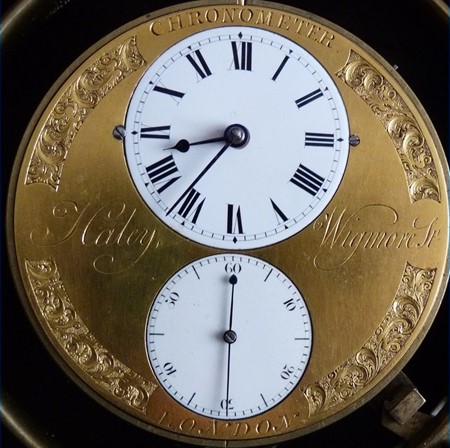
Richard Thomson, Secretary Scottish Branch
10 April 2021 – Colin Graham. ‘Online Selling – Stay Safe, Make Money & Keep Horology Alive’
In April we had a presentation by Colin Graham BHI Scotland Branch ‘Online Selling – Stay Safe, Make Money & Keep Horology Alive’
Colin has a long history of using the internet and believes that he was probably the first Internet user in his town of Selkirk. What is certain is that he has more experience than other branch members of trading on the web. Both with his website www.colinswatches.com and a much used eBay store selling horological related items. We were keen to learn how to emulate him safely.
He started by asking the question of how to address the loss of skills we see in horology. True the web can be a great source for knowledge and the BHI run some excellent distance learning courses but there still is a need for hands on training and one to one instruction. He pointed out that some, once common parts, are now just unobtainable. (This is not just restricted to horology. As a kid I made flying models from Balsa wood, tissue & dope. Later I made ham radios. Now these pastimes still exist but only by buying the latest premade drone or transceiver. It’s all about buying product with no skills required to create.)
He discussed the four online majors he has used. Catawiki, Etsy, Amazon and eBay. The last two needed no introduction but hopefully I’m not alone in never hearing of Catawiki before. As a seller it was explained that you need to get the pricing correct and not to forget postage, and the fees that all the platforms charge for their service. As a buyer he explained the ways to pay safely and not have any nasty surprises. He illustrated his safety talk by showing examples of fakes and how to spot them. He also helped translate some of the descriptions used which should ring alarm bells about the quality of the item and its provenance.
I took away at least two bits of sage advice: When selling know your subject. It will let you get the right price and good feedback from the buyer. Also never buy anything after the third Gin n’ Tonic in an evening!
The branch extends its great thanks to Colin for giving us an excellent contribution to this years events.
Richard Thomson, Secretary Scottish Branch.
13 March 2021 – speaker Dr Zen Chowaniec “A little Horological Dentistry”
As could be guessed from the title Zens focus was on gear teeth and how to repair them. He had previously given a presentation on his repairs to a Junghans 3 train bracket clock in early 2020. Sadly this clock experienced more gear issues and was returned by the customer as “Not Working”. Even more stressing was that the new issue was, in part, a failure of some of the previous repair work. This was to do with the rather unusual winding arrangement used in these clocks.
He presented a forensic diagnosis of the issues and what had caused the original and new failures. There is a design issue with the original clock and other examples have displayed the same issues. Rather than the normal click arrangement using a sawtooth shaped ratchet the going train uses a click pushed into a gear wheel. Fig 1 vs Fig 2. The stresses in this design are not well handled by the tooth shape. To make matters worse the number of teeth used on each gear ensured that the wear was not spread evenly over all the teeth.
Repairs were carried out by cutting new gears. This was complicated by the originals not being either Cycloidal or Involute but something in-between. Zen explained the differences in tooth shape and how he calculated the design of the new gears by calculating the Module or the Diametral Pitch. (Metric Vs Imperial systems) Once designed he was able to cut new gears by combining his mill drill and a dividing head. I fear that his description hid a great deal of exacting work that would challenge most others. He extended his thanks to Archie McQuater and Brian Cathcart for advice and encouragement and recommended Malcolm Wilds book “Wheel and Pinion Cutting in Horology”
The branch extends its great thanks to Zen for giving us another excellent contribution to this years events.
Richard Thomson, Secretary Scottish Branch.

Fig 1 Conventional Ratchet Arrangement
Fig 2 Junghans Click
13 February 2021 – speaker Tomek Borkowy. ‘It’s All About Watches’
This month we had a presentation by Tomek Borkowy ‘It’s all about Watches’.
The title came from the Polish watch festival. This festival celebrates the rebirth of the Polish watch industry after the dark days in 1983 when the Polish watchmaking school was closed. The festival has had 4 editions. The last in Sept 2020 had to be virtual for the obvious reasons.
Firstly a little background. Tomek is an actor and producer / theatre director. Despite appearing in Taggart, Lovejoy, Dr Who and more in this country he is probably better known in his native Poland where he appeared in a TV series ‘Dom’ which ran over 20 years. He left Poland and adopted Edinburgh as his home town in the early 80s. Being a famous son of Poland he was invited to the first Festival as a guest and is now an ambassador for the event.
He presented a series of images that he had taken when attending the events and talked about the well known to the west brands, Omega, Longines, Victorinox that attended, and also the home grown products Balticus (now for sale in the UK) Czasownia, Polpora which are certainly less well known but of a very high standard.
Indeed there are some very high end producers now making bespoke timepieces retailing for 10s of thousands dollars. As Poland is an East meets West place the festival also attracted some top Russian brands. Sturmanskie not only brought their Pilot Chronograph with a picture of a cosmonaut on the back they brought the real life cosmonaut ( Mirosław Hermaszewski) to pose with it and sign autographs. The picture shows Hermaszewski left and our speaker right.
It is always nice to meet members and find out a little about them. Tomek briefly mentioned his own design of wrist watches and the sourcing of cases for them. This could easily form a presentation in its own right some day.
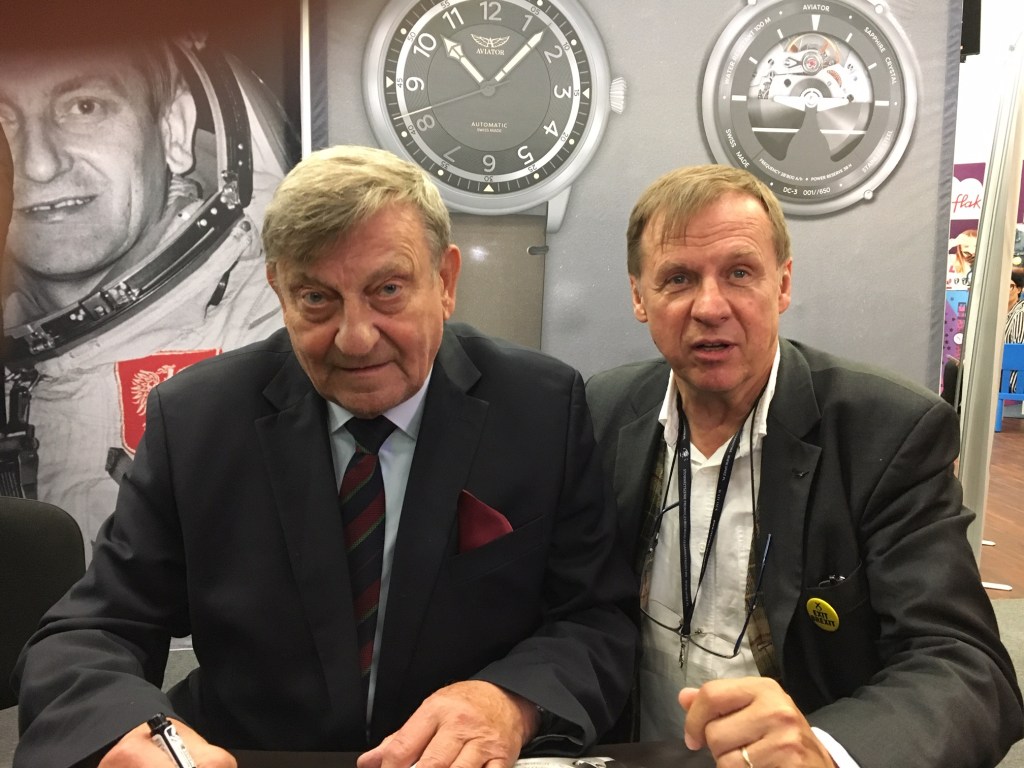
The branch extends its great thanks to Tomek for giving us a taste of what we have missed in the way of live events this past year.
9 January 2021 – Bring and Discuss
This month we had a virtual bring and discuss. 4 presenters stepped forward to provide an interesting afternoon. It was our best attended and longest meeting in this new era of isolation.
1. Zen Chowaniec “Two Marine Chronometers from the 1980s”
Zen showed us two marine chronometers that he had collected at auctions. The first was a quartz movement which looked fairly typical of 1980s zero jewel quartz movements complete with wall mounting hook and single ‘C’ cell power. It was cased to look like a regular Marine chronometer and was supplied as conforming to the relevant standards of accuracy. The second, dated 1982, provided a striking contrast. It was a Russian ‘Pilot’ (Poljot) brand made in the same group as Sekonda watches the First Moscow Watch Factory (1st MWF Kirova). The mechanism was an epic gold plated brass one with chronometer escapement and chain fuse.
2. John Mason “Questions on French Clock repairs”
John joined us for the first time from his home in Aberdeenshire. He has been busy restoring some French clocks and was keen to get some advice on working with these mechanisms. Well ask a group of experts for an opinion and it gets quite lively. The subjects covered ranged from just how lose should the beat adjustment be to how long will ammonia cleaning solution last. I’m the last to know, or take sides, but feel safe in saying that if ammonia is used then do it in a well ventilated space.
3. And from Germany, Thomas Meine. ‘Magnetism and watches and how to solve it’
Thomas gave us a presentation on how magnetism affects quartz and mechanical watch types. I did not know that quartz watches can stop if subjected to 1000 Gauss. (Gauss is the cgs unit of measurement of a magnetic field. The Earth’s magnetic field measures about 0.5 gauss, a small iron magnet has a field of about 100 gauss, a small neodymium-iron-boron (NIB) magnet has a field of about 2,000 gauss) Mechanical watches can be badly affected by much lower field strengths. For example by sitting beside a bookshelf loudspeaker. The primary weakness is the hairspring that can be made to stick together and effectively shorten making the watch run fast. Some advice was given on selecting a demagnetiser. As ever you get what you pay for and caution was expressed at using the lower priced units (£5 from China) as these can do more harm than good. Note: An ‘antimagnetic’ watch is only protected to 60.3 gauss. DIN8309. However some luxury brands can be much much higher.
4. Last but not least Kenneth Russell “Brass Screwdrivers”
Ken joined us for the first time and showed us the brass screwdrivers he had made for working on clocks. Typical steel precision screwdrivers had been modified by replacing the steel blades with hand filed brass inserts. These will cause a lot less distress to blued steel screws. Thus retaining the original beauty and rust proofing that the blueing provides.
My great thanks to all those that presented and to those that turned up to listen and ask the questions and debate the answers.
12 December 2020 – speaker Lyndsay McGill, Curator, Renaissance & Early Modern History, Department of Scottish History & Archaeology, National Museum of Scotland. ‘Andrew Purdoune: An Early Scottish Maker of Lantern Clocks’
This month we had the pleasure of welcoming Lyndsay McGill, Curator, Renaissance & Early Modern History, Department of Scottish History & Archaeology, National Museum of Scotland. To give us a virtual lecture on ‘Andrew Purdoune: An Early Scottish Maker of Lantern Clocks’
Andrew Purdoune was a Glasgow based Clockmaker in the mid 17th Century. Lyndsay took us through the research that she had carried out, in 2018, after discovering a clock of his in the National Museum of Scotland collection. It posed an intriguing question. Was Andrew Purdoune the First Scottish clockmaker?
She gave us a brief overview of father and son Humphry and Richard Mills work and that of John Alexander. All clockmakers of that early period. Were this lantern clock of Andrews made in London? An analysis of the engraving on the dial showed strong similarities to that of, a most definitive Scottish item, a Silver Quaich design of the period. With references to the ‘Tulip Mania’ of the 1630s. Tulips, then as now, coming from Holland. Indeed Andrew was shown to have travelled to the low countries to study the latest in clock technology. Christiaan Huygens, of course, invented the pendulum clock there in 1656.
For me the talk was packed full of references to things partly forgotten and old Scots texts that were a delight to have deciphered for us. I spent some time afterwards just looking up who Hammermen were (and are) Who was a cordiner (cordwainer) and why they should not be confused with a cobbler. Even the fee of £5 for looking after the Glasgow Tolbooth clock for a year, (According to the National archives around £550 in todays terms.) was fascinating. The branch extends the greatest thanks to Lyndsay for her time and rounding off this year on a high.
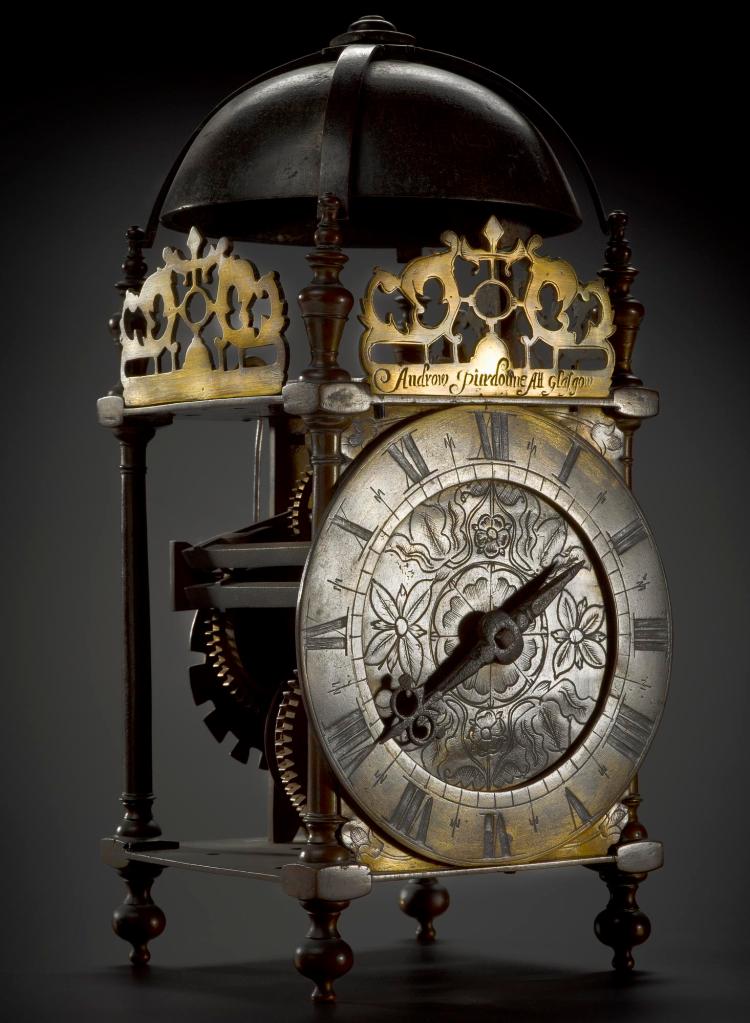
14 November 2020 – Bring and Discuss
This month we had a virtual bring and discuss. 3 presenters stepped forward to provide an interesting afternoon.
1. Peter Mehta “A novel repair technique during lockdown”
Peter talked about restoring a wall clock that had been so badly water damaged that many would have binned the remains. The clock had lost most of its octagonal wooden moulding around the dial. An artist acquaintance had been able to reconstruct this using ‘DAS’ modelling clay and remarkable wood like staining to recreate the missing pieces. He also talked about his use of the new type of UV curing glues to repair the rating nut thread that had sheared off.
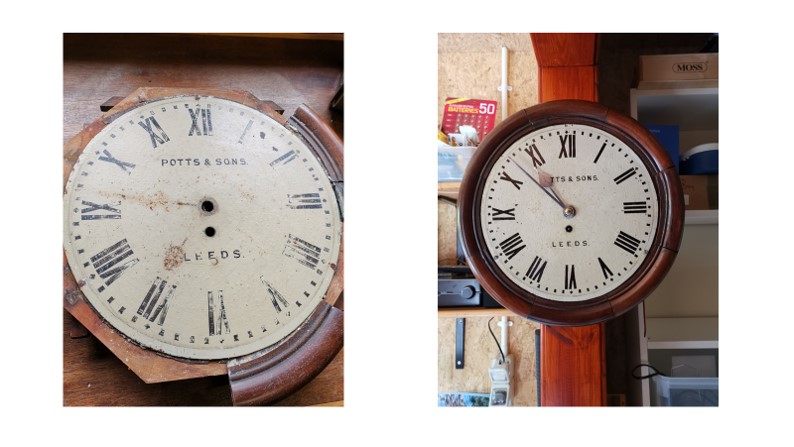
2. Zen Chowaniec “Three Repair Projects”
a. Reinstatement of Calendar Wheel on a French Ormolu Two Train Mantel Clock
b. Repairs to a Twin Fusee Verge Bracket Clock
c. New Barrel Arbor Hooks for HAC Arts & Crafts Period Mantel Clock.
Zen showed a considerable amount of skill in different techniques to affect these repairs. The first two also required a good understanding of how the items were supposed to operate to diagnose the repairs required. There followed a lively discussion on the relative methods of blackening hands in preference to the ‘bluing’ technique that is hard to make even on old hands. Dipping hot hands in old engine oil and chemical blackening both had good support from the group.
3. A new friend of the branch from Germany, Thomas Meine.
One of the benefits of a virtual meeting was that we were able to be joined by Thomas from his home in Frankfurt. Thomas collects watches of all types and has written a couple of books on the subject and another on radioactive dials. He wanted to ask the group about one of his watches ‘made’ in Inverness by Fehrenbach & Boch. in 1868 (Fig 1.)
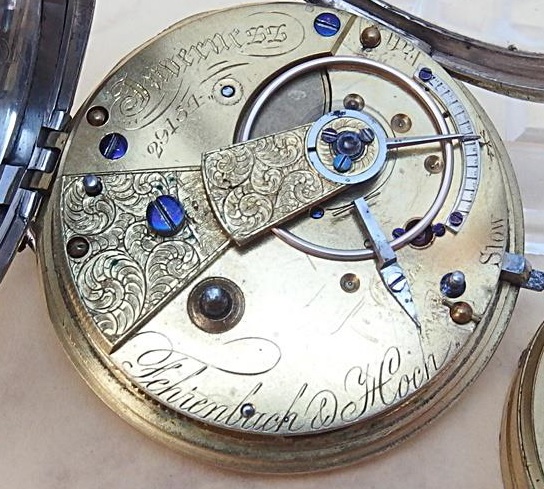
The feeling was that it was probably made in London as it has London hallmarks and had been engraved for the retailer. The spelling of the second name could be an error. If any HJ reader can recognise the movement or know more about the retailer please get in touch. Lastly he talked about an adjustable table for adjusting the beat in clocks. An idea now taken up by the Bavarian clockmakers school.
10 October 2020 – speaker Ashley Strachan. ‘A Tale of Four Repeating Pocket Watches’
Ashley gave our last ‘in person’ presentation back in March just as the world was changing. Some members were unable to attend as a result so he graciously agreed to give his talk again this season. This time it was in full virtual mode. Not content with his previous presentation he did a complete rewrite and covered his subject from a totally different angle.
We were treated to a potted history of how repeaters originated and of the different types. I noted that in 1687 King James II ran a competition. There were two entrants Tompion and Barlow. Barlow won with his single button design to trigger the striking. This did remind me of the recently announced “Earthshot Prize”
Ashley then described in detail his 4 watches, their origins and faults on acquisition. The oldest is a 1720’s Bordier a Geneva – Quarter Repeater – Silver pair case with champlevé dial, retailed by Kaltenbrunner, Prague. This is shown in Fig 1.
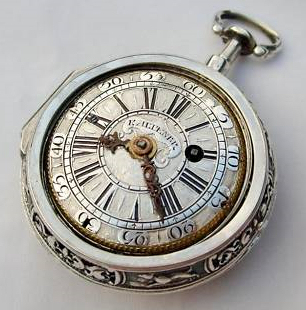
His second oldest is a 1760’s Jean Antoine Lepine – Quarter Repeater – Gilt case with diamonds and rubies and enamel dial. This is shown in Fig 2.
This was followed by a 1824 Robert Bryson Qtr. Repeat “Pendant Gong” and last, but by no means least, an 1830 Lepine Qtr. Repeat “Slider Gong”
He admitted that he did have an eye to their investment potential but took daily pleasure from seeing them and was sympathetically restoring them to a running order as time allows. He paid tribute to the assistance given by another member Jurgen Tubbecke in tackling some of the trickier repairs.
He concluded his presentation by talking about a 5th watch bought off a well known auction site and the issue of it not turning up. It was good to know that the full refund operation kicked in so rapidly and prevented a very bad day indeed.
Thank you Ashley for starting our season with such a high standard of talk.”
The 2020/21 programme of events began with the Branch AGM followed by a Bring and Discuss session. For the programme for the coming year see under the EVENTS tab
Minutes of 2020 AGM (Draft)
The Annual General Meeting of the BHI Scotland Branch was held virtually on Saturday 12th September 2020 at 2.00pm. 18 Branch members attended.
AGENDA
- Apologies
- Minutes of Branch AGM 12th January 2019
- Matters arising
- Chairman’s Report
- Secretary’s Report
- Treasurer’s Report
- Election of Committee
- AOB
- Approval of Minutes, Reports and Elections
1) Apologies
Alastair Walker, Tomek Borkowy
2) Minutes of Branch AGM 12th January 2019
Approval of minutes under item i) of the agenda.
3) Matters Arising – None
4) Chairman’s Report (Matthew Richards)
This meeting marks our first AGM at its new time in September. Although it’s been an interesting journey from the January 2019 AGM I feel that the Branch remains in good shape.
Our initial meetings of 2019 were of their usual high standard, but unfortunately we were soon into COVID and had to cancel the meetings in April and May 2020. To protect our members, and because of the uncertainty around the future, we decided that at least the first few meetings of this new season would be held virtually. This was at Richard Thomson’s suggestion and I welcome him to the committee and also thank him for recommending Jitsi, the meeting platform we are using for our virtual meetings.
We still don’t know how COVID will evolve, but until the Museum of Edinburgh reopens and it is safe to hold meetings in person we will continue to hold them virtually. I hope that members find them easy to access, but please let us know of any problems. Thanks to the entire committee for their work and dedication.
At the last AGM I took over from Ashley and would like to thank him. He was a great Chairman and remains a very welcome visitor to the Branch whether attending or giving one of his always fascinating talks.
I’d also like to extend thanks to all our loyal members, without whom the Branch would not exist. Your support, particularly in these challenging times, is much appreciated.
Lastly, I’m sad to remind members that Zen is stepping down as Secretary after spending huge amounts of his time on Branch matters over the last six years. We were incredibly lucky to have him as secretary and he has done an outstanding job in all aspects of the role.
He will be hugely missed. My heartfelt thanks go to him for all of the work that he has put in over the years and for ensuring a seamless transfer to Mark Baird and Richard Thomson.
How Mark and Richard share the work may well evolve in future but initially Mark will deal with membership matters whilst Richard will deal with meetings and speakers. Thanks to both of you for taking on these roles.
Approval of Chairman’s Report under item i) of the agenda.
5) Secretary’s Report (Zen Chowaniec)
Membership
Branch membership stands at 70 (6 Fellows, 6 Members, 58 Associates) with 22 Friends. Since the last AGM our membership has grown by six (Associates) and seven Friends (six of whom were recruited at the Edinburgh Antiques, Vintage and Collectors Fair in May 2019. Two members resigned from the BHI but retained their contact with the Branch as Friends. Sadly, there were five deaths in this period, including Bill Borthwick, Frank Briglmen, Colin Campbell, Ian Hair and John Redfern.
Events
The Branch’s 2019/20 programme comprised 10 events including, for the first time, a Christmas lunch in December. The April and May meetings had to be cancelled due to the coronavirus pandemic.
Details of our 2020/21 programme are shown
Meetings Venue
In January 2020 the Canons’ Gait informed us that the function room the Branch had been using for its meetings since 2012 would no longer be available to us from March onwards. After reviewing several alternatives the Museum of Edinburgh was chosen as the new venue. Located at 142 Canongate, EH8 8DD, a short walk from the old venue down the Royal Mile, it retains good visitor access by public or private transport and offers better facilities for our speakers, but now at a cost of £75 + VAT (£90) per meeting (the Canons’ Gait was free). We continue to use the Canons’ Gait for lunch for the time being.
The forced cancellation of our April and May events due to the coronavirus pandemic led the Branch Committee to explore the possibility of holding Branch meetings virtually. This was found to work very well and in consequence all future meetings will be held virtually until such time as we can return safely to the Museum of Edinburgh.
Although the social aspect of our meetings is important the great advantage of holding them virtually is that, for the first time, everyone in the Branch should be able to take part irrespective of their location.
Branch Website
We now have a ‘Webmaster’ (Peter Mehta) to update the data on the Branch’s website. Mark Baird has undertaken to revamp the site including removal of the historical (and confusing) reference to ‘East of Scotland’ in the domain name. It is proposed to change the web hosting company from GoDaddy to WordPress as the latter includes regular maintenance of the website software by the provider (hitherto a source of some difficulty for the Branch).
Approval of Secretary’s Report under item i) of the agenda.
6) Treasurer’s Report (Frank DiCarlo)
Summary of Accounts for 2019:
- Branch financial status remains healthy but diminishing year on year.
- Overall Balance is £4,516.96 when all commitments are paid.
– Change in year was minus £283.04, this was dominated by Speakers fees.
- Main income was meeting subs at £364
- Main outgoings were:
– Speakers fees (£293)
– Domain name for website (£131)
– Secretary Expenses
- Accounts for 2018 and 2019 were Reviewed and Approved by Colin Graham of “colinswatches”.
- 2020 was a short year with only three meetings and a finishing balance of £4,380.25. Volunteer to review Accounts requested.
Note: At present, the main financial concerns for the future are:-
– likely rental costs for meeting place.
– external (online) Speaker costs, with no income from Subs.
Approval of Treasurer’s Report under item i) of the agenda.
7) Election of Committee
Zen Chowaniec (Branch Secretary) and Bill Lamond stood down from the Committee.
Election of New BHI Scotland Branch Secretary
Richard Thomson was elected unopposed as Branch Secretary. Membership matters will be devolved to Mark Baird.
Election of Rest of Committee
Mathew Richards (Chairman), Mark Baird (Vice-Chairman and Membership Secretary), Frank DiCarlo (Treasurer) and Paul Wood agreed to remain on the Committee for another year.
Peter Mehta (Webmaster) is an ex-officio member of the Branch Committee and agreed to continue in that role.
Approval of elections under item i) of the agenda.
8) AOB
None
9) Approval of Minutes, Reports and Elections
In a departure from previous practice approval of the 2019 AGM Minutes, 2020 AGM Reports and elections to the Branch Committee was undertaken collectively at the end of the meeting. Approved by Duncan Massie, seconded by Peter Mehta.
Zen Chowaniec, Retiring Branch Secretary
 BHI Scotland Branch