Blue Plaque Dedication to John Smith of Pittenweem 18th September, 2026.
It is a glamourous life being the Secretary of the BHI Scotland Branch. Hobnobbing with the rich and famous. Heads of State on speed dial. Endless dates with supermodels. In fact, it was during one of these hallucinations that an Email flooded in.
It was an invitation to attend the unveiling of a ‘Blue Plaque’ in honour of John Smith of Pittenweem. To be followed by a Champagne reception. It was sent by Hazel Mills a trustee of Pittenweem Community Library. I was only too eager to clear my diary for the day, sorry Claudia, to attend.
Now, as I hope is well known, John Smith (1740-1814) was one of Scotland’s finest clockmakers. Possibly less well known is that Pittenweem is a small fishing port on the east coast of Fife. Back then it was even smaller. I have always wondered how and why John would have been able to build such a prestigious reputation from there and not been forced to migrate to Edinburgh, Birmingham or London. Even more confused to learn that there was another John Smith, clockmaker, also in Pittenweem around the same time. There is an excellent article by John Hunter, (Clocks Magazine Sept. 2010) where he deep dives into the genealogy of the Smith family. Sadly, not all parish records survive, and details are hard to piece together. However, it is clear that they both overlapped.
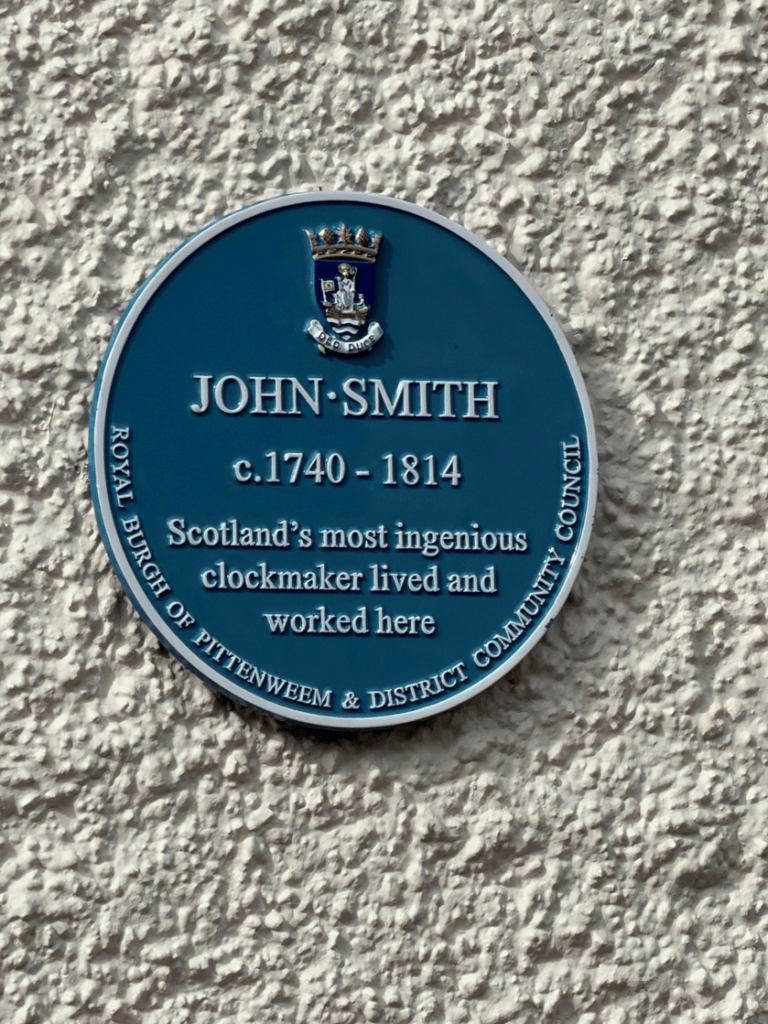
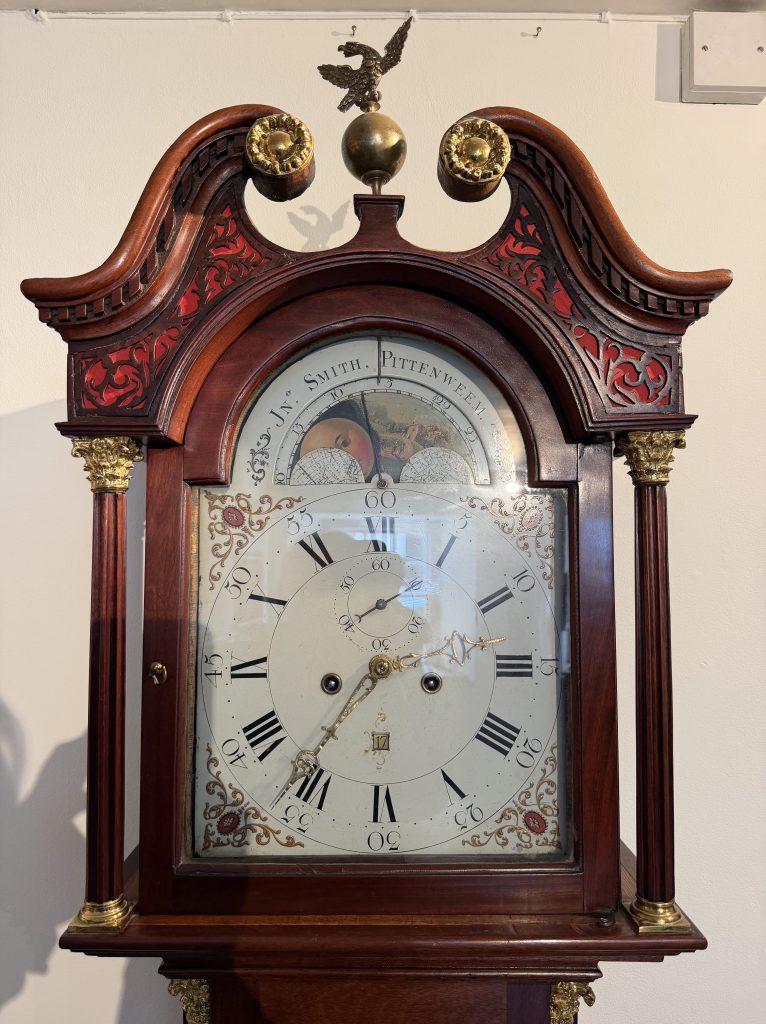
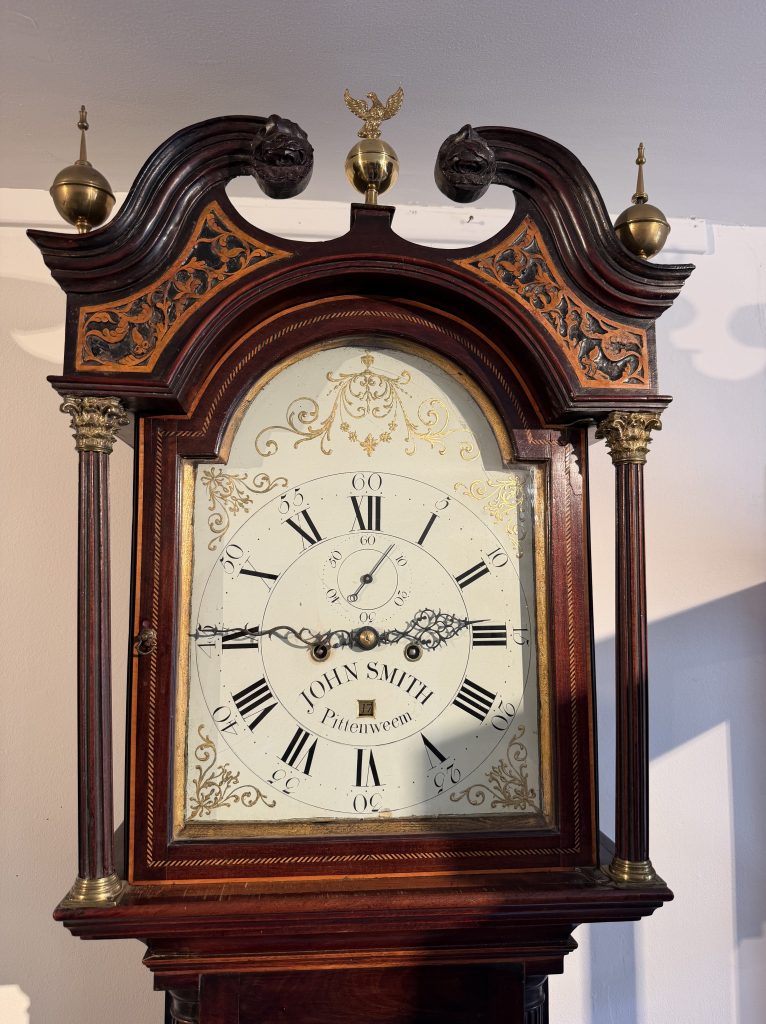
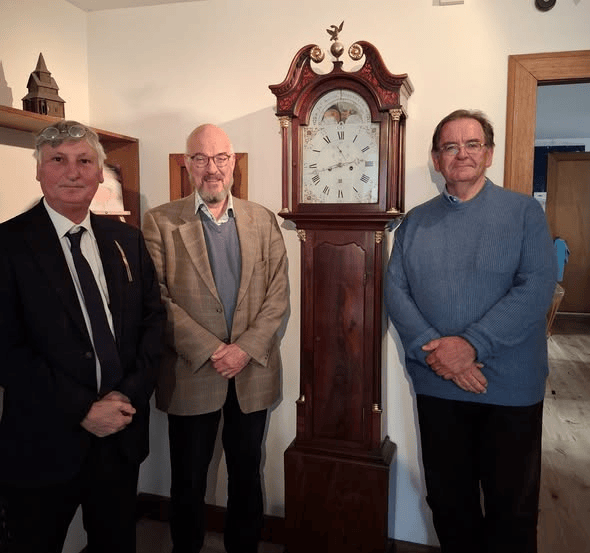
On the day we found ourselves in the midst of a group of ‘Smithies’ standing opposite the site of Smith’s former house and workshop. Now adorned with the plaque shown in figure 1. (19 High Street, Pittenweem) It had clearly been a considerable body of work to get to this stage. After short speeches of thanks to all those involved in the process of getting the plaque created and installed, we retired to the property next door. It is a private home and was generously loaned out for the reception. Champagne was indeed handed out and we gathered to hear a speech from Eric Young, MBHI, on the life and work of John Smith. Eric has had the opportunity to work on many Smith clocks and had arranged for two of them to be displayed during the reception. (See figures 2 & 3) I Quote from Erics Speech: “What sets John Smith apart from all the other hundreds of clockmakers of his time was his determination to expand his creative mind and take clockmaking into the public eye as a way to express joy in that time, the wonder of that time and a celebration of music on bells and rolling moons looking down on the passing trade ships on the Forth estuary.”
We studied the clocks on display. I was drawn to the inscriptions being different. One was JOHN SMITH in capitals, and the other was Jno Smith. I did think that this was possibly a different Smiths work but I was wrong. Both are by THE John Smith of Pittenweem. In Georgian horology, the signature “Jno Smith” is a standard 18th-century scribal abbreviation for John Smith. Moreover, he did not always use “of Pittenweem”. Sometimes he used “Anstruther” or “North Britian”. The latter is thought to be a declaration of patriotism following the disastrous invasion of England by a Scots army led by Bonnie Prince Charlie in 1745. Ah those were the days.
During the reception I was intrigued to learn that the house that we were in had belonged to a carpenter who had made cases for Smiths clocks. Perhaps even the ones on show. The clock cases he used are characterized by high-end, elegant architecture that heavily favoured the Edinburgh style of the George III and early Regency periods. While he manufactured the movements locally in Fife, he paired them with premium, expertly crafted wooden cases to appeal to wealthy merchants and aristocratic clients.
From Eric I learnt that Fife was full of horologists back then. Each little village had its own clockmaker, so Pittenweem did not seem so unusual. Indeed, it was a port which probably gave it as good an access to Amsterdam as to Birmingham. However very few others approached Smiths level of complexity. Think Carillon of six or more bells rather than passing strike. His clocks frequently feature high-water tidal pointers and rolling moon phase discs built into the dial arch to assist seafaring Fife clients.
He became globally renowned for his highly complex musical automaton longcase clocks. He famously engineered “Sabbath-observing mechanisms.” At Saturday midnight, a plaque reading “Remember Sunday” would slide into view, and the clock’s musical barrels and striking hammers would freeze in total silence for 24 hours out of respect for the Christian day of rest. Religion played an important part of his life. He built a tower clock in memory of his first wife for his local church. He also had his own seat built for him in the Scholars & Sailors loft of the church.
For his highly complex masterpiece automaton and musical clocks, the cases transcended standard furniture and became structural works of art. The Royal Pedestal Clock (Clarence House), his most famous piece, features a magnificent theatrical carved and gilded oak case. It is framed by neoclassical Corinthian columns at the angles and intricate fretwork foliate broken arches to emphasize its royal stature. Experts believe John Smith may have purchased this ultra-premium case directly from a specialist London case maker during his exhibition trip to the capital in 1808.
Figure 4 shows some of the team involved in getting the plaque installed. From left to right: Jane Forbes (Trustee, Pittenweem Community Library), David Miller (owner of the house that belonged to John Smith), David Jones (furniture historian), Hazel Mills (Trustee, Pittenweem Community Library), Toby and Kate Anstruther of Balcaskie estate. They are to be congratulated on their efforts to celebrate Scotland’s “most ingenious” Clockmaker.
Richard Thomson, Scotland Branch Secretary.
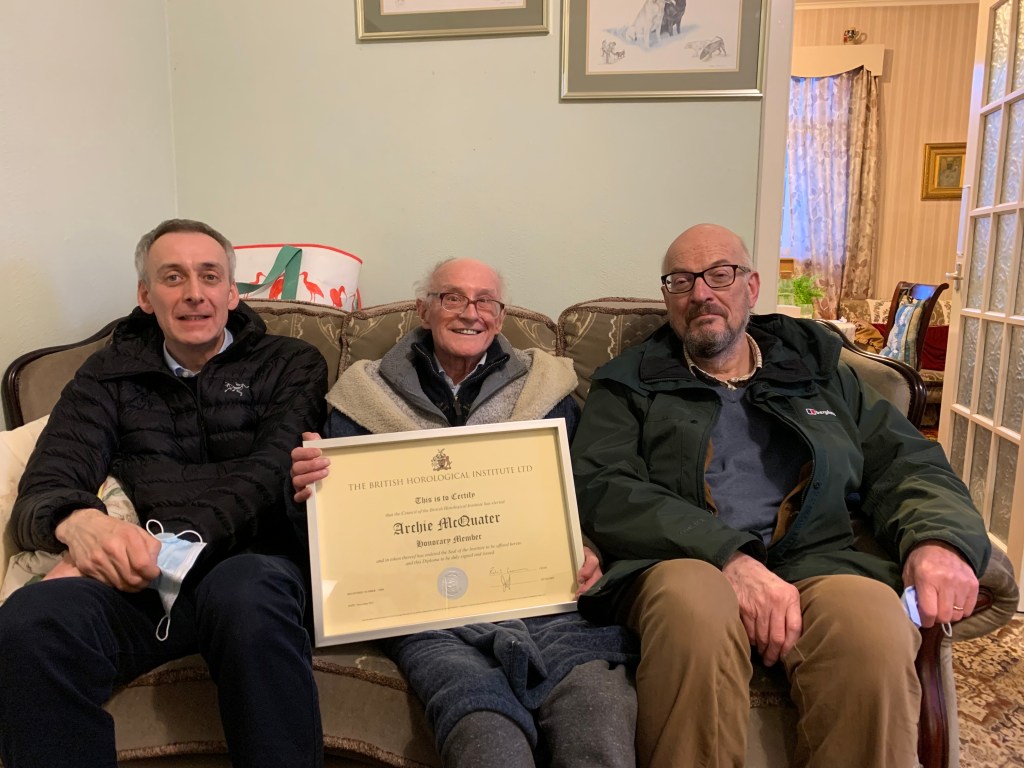
Dec 2021 Archie McQuater Hon MBHI Award
In 1946 Archie was conscripted into the army, serving for three years with the Royal Engineers. Working in bomb disposal he learned a great deal about small mechanisms, to say nothing of the need for a very steady hand. This focussed his thoughts on becoming a watch and clock repairer and on completing his military service he became an apprentice watchmaker with Williamson Jewellers in Bruntsfield Place in Edinburgh.
Archie has few fond memories of his apprenticeship, describing the owner of the shop as being something of a slave driver. He recalls that there were five apprentices sitting side by side at a long bench. Every year each apprentice moved up a space, the top apprentice having to leave. Archie spent six years with Williamson’s. His earnings at the time were not enough to pay for his digs so he took on a second job as a window cleaner, working early mornings and evenings.
On completing his apprenticeship Archie moved to the Edinburgh Watch Company, also in Bruntsfield Place, where he worked for three years before moving to James Ness Jewellers in Queensferry Street. Working mainly on top-end watches he was now earning a good wage, eventually becoming the foreman.
In 1959 a friend of Archie’s persuaded him to join Ferranti where the pay and conditions were very much better than those of a foreman watchmaker and the plentiful overtime came in handy to support his young family. Archie remembers the year well as it coincided with the worst smog Edinburgh had ever experienced. Initially working in the potentiometer section Archie worked his way up to be a charge hand. He then had the opportunity to become a staff member in the inspection department.
Throughout his time at Ferranti Archie continued to repair watches and clocks in his spare time, making a lot of his own tools and even a watch cleaning machine.
Archie retired from Ferranti in 1987 and immediately started working again as a watch and clock repairer for James Walker Jewellers in Edinburgh. After a year he moved to become the watch and clock repairer for Keith Walter Jewellers in Peebles where he worked until his second retirement 11 years later. Archie recollects that he would work one week on watches and then the next week on clocks, never mixing the two so that he could maintain his ‘feel’ when undertaking delicate watch work.
However, Archie’s second retirement didn’t last long and in 2000 he found himself working at Craiglea Clocks in Comiston Road in Edinburgh, his only concession to advancing years being that he now restricted his work almost entirely to clocks. Archie retired, for the third time, from Craiglea Clocks in the summer of 2021, and then only because of deteriorating eyesight.
Archie was persuaded to join the BHI by the late Nick Sanders in the early 1980s and has been an active member ever since. He has given several talks to the Scotland Branch over the years and provided generous help to other Branch members, both amateur and professional alike. He has made several clocks, a Ptolemaic planetarium, featured in the June 2014 edition of the HJ, and is currently finishing a complex automaton clock featuring a family of robins. What is truly remarkable is that these projects were completed without drawings or sketches, just relying on Archie’s quite amazing memory.
Archie is delighted to have been awarded his Honorary MBHI, a richly deserved accolade for a very wonderful man.
Dr Zen Chowaniec